New Hardware LCFModGeeks – The Complete Guide to the Latest Innovations
Search new hardware lcfmodgeeks and a complete product line comes back: a generation of devices with high-speed processors, models for gamers, students and businesses, prices that rise from affordable to advanced, and experts praising all of it. The description is finished in every detail except one. There is no such product line. No company makes it, no shop sells it, and no model of it has ever been listed anywhere.
The name behind the guide does have a website, and the website has a documented life — it just has nothing to do with hardware. The address lcfmodgeeks.com was registered in January 2025 and spent its captured life as a download blog for phone games, heavy on Minecraft APK files and game mods. Today it serves no content at all: the domain is parked on a sale page, offered to any buyer for $1,000.
This article keeps the guide’s own structure and tests its claims one by one against the registry, the archive and the name’s own pages. No model, price, specification or performance figure is printed as fact anywhere below, because none exists to print; where the guide asserts them, they are printed as its claims.
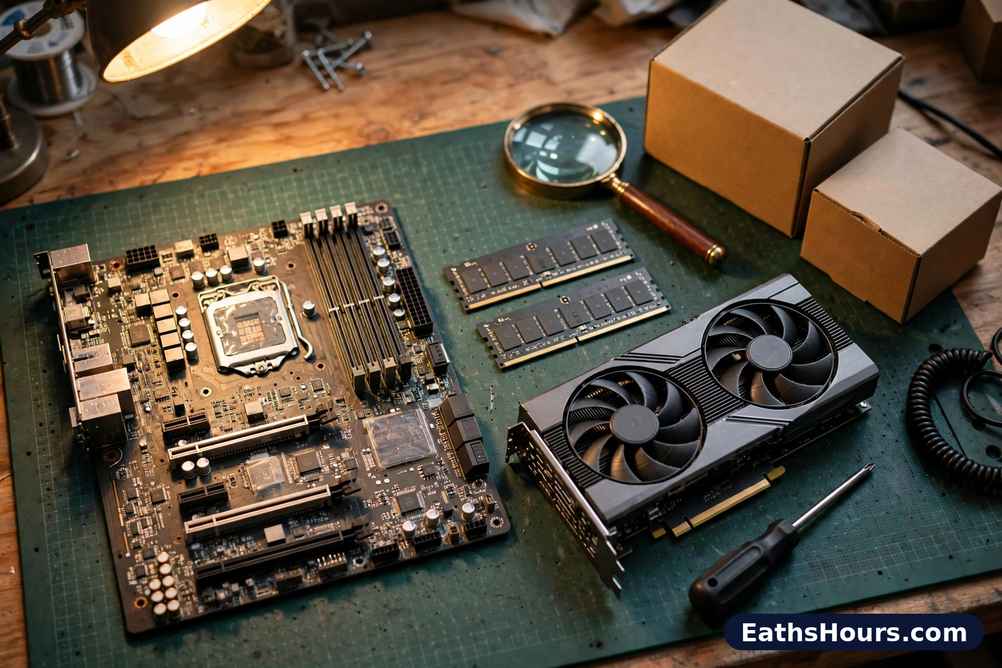
The Checks: What Can Actually Be Verified
The method used here is the same one this run applied to xucvihkds, to why kiolopobgofit important and to g15tools com gadget: read what the address itself serves, check the registry and the archive, and let the record speak before any guide does. Applied to this guide, the census is:
| # | Claim, as the guide prints it | What the record shows | Verdict |
|---|---|---|---|
| 1 | A hardware product line exists under the name LCFModGeeks | No maker, company, product, model or shop appears in any record checked; the name’s own website never sold, listed or reviewed a single device | Does not exist |
| 2 | Four key features: high-speed processors, energy-saving design, strong build quality, easy setup | Features of unnamed products — there is no model, datasheet or specification sheet for any of them to attach to | Claims only — nothing to attach them to |
| 3 | Models at prices from affordable basic to costly advanced | No price for any “LCFModGeeks” product exists anywhere; the only price attached to the name is the $1,000 asking price for the domain itself | No prices exist |
| 4 | A history: developers spent years improving processors, memory and storage until the line was born | No founder, company, launch or earlier model appears in any record; the domain behind the name was registered on 7 January 2025 | Invented history |
| 5 | Gamers, students and businesses are adopting it, and people are switching to it | No user, benchmark, review, forum report or sales record of any such product exists | Unverifiable claims |
| 6 | Experts praise it and reviews show high satisfaction | The guide names no expert and cites no review; the only opinions in circulation are the copying network’s own pages, which disagree about what the name even means | No experts on record |
| 7 | (Printed by other copies) LCFModGeeks is a hardware brand making modular computing components | The name’s own website was a game-download blog; across the 213 URLs the archive holds for it, not one contains the word “hardware” | Contradicted by the site itself |
| 8 | (Printed by one copy) “LCF” stands for Low-Cost Framework Modular, with named models and industry reports behind it | The named models and reports surface nowhere outside that single article; the site itself expands the letters nowhere | Invented expansion and models |
| 9 | (Printed by another copy) “LCF” stands for Low-Cost Firmware Modifications for Geeks | A different expansion from row 8’s, likewise absent from the site itself | Invented expansion |
| 10 | (Printed by another copy) A gaming platform launched on 15 August 2025 by a named founder | The date and the founder appear only in that copy; the site’s captures from that season show a Minecraft APK download page | Claims only |
One point in the census deserves emphasis before the sections begin, because it decides how the name is handled in this article. The guide is not careless in the usual way: its structure is complete, its advice is sensible, its tone is calm. The failure is underneath all of that. Every section describes an object — a device, its models, its users, its problems, its price — and the object is not there. What is there instead is a search term, a borrowed website name, and a network of pages describing both as if they were a manufacturer.
What Makes New Hardware LCFModGeeks Special?
The guide’s answer is comparative: higher speed, improved durability and smarter features compared to older models, which is why it is “becoming a top choice for gamers, students, and businesses”. A comparison needs two sides, and neither side exists. There are no new models to measure, because there are no models; there are no older LCFModGeeks models to beat, because there were never any at all. Speed, durability and smartness are numbers and tests in real hardware writing — a clock rate, a drop test, a named sensor. Here they are adjectives with nothing underneath them.
What genuinely makes the phrase special is visible in the guide’s own first line: it calls the term “a trending topic”. That is the one accurate sentence in the section, and it explains the page. The guide exists because people search the phrase; the phrase trends because guides like this one keep describing it. A product would need a maker to be special. A keyword only needs other pages.
History of New Hardware LCFModGeeks
The guide’s history runs: the story began with the need for faster and more reliable devices; over the years, developers worked on better processors, memory and storage; eventually the idea of new hardware LCFModGeeks was born. No developer is named, no company is named, no year is given, and no earlier product is identified — a history with no people, no places and no dates in it. Set against the documented history of the name itself, the contrast is total. The domain lcfmodgeeks.com was registered on 7 January 2025, through Unstoppable Domains. Within days the archive holds its first captures, and by the time this guide was published, in September 2025, the site at the address was offering phone-game downloads. The name’s entire recorded past fits inside a single year, and none of it involves a device.
One detail inside the guide’s own history paragraph shows how the text was assembled. In his telling, the words “new hardware LCFModGeeks” are a hyperlink — to the same guide, mirrored on a golf site, jbsagolf.com. That anchor is not reproduced here. Injected and mirrored links of that kind are the fingerprints of the copying network these guides travel through: the history was not written from any company’s records, because there is no company; it was written from other copies of itself.
What the Address Actually Serves: A Game-Download Blog, Now a For-Sale Sign
Because the whole guide rests on the name, the name’s own website deserves a section of its own. The archive holds 17 captures of its homepage between January 2025 and June 2026, and 213 captured URLs in all. The content is consistent throughout: downloads for Android games. The September 2025 capture — taken eight days after this guide was published — is headed “Minecraft APK v1.21.110.23 Download | Pocket Edition Free”. The June 2026 capture offers a newer Minecraft APK version alongside a Stumble Guys mod APK. Its article titles run to things like “Boost Your Gaming: Discover Incredible Mods with LCFModGeeks” and “Best Games Covered by LCFModGeeks”. Its categories are gaming, technology, entertainment and the like; an author archive exists under a single byline name. Its About page describes no company, no team and no products — it carries the name, the menu and a copyright line, and nothing else. Across all 213 archived URLs, not one contains the word “hardware”.

That career has now ended. The domain’s nameservers point at the Afternic and Sedo parking services, and the address today returns a sale page: lcfmodgeeks.com is offered to any buyer for $1,000. So the documented life of the name runs in three acts — registered in January 2025, a game-download blog through the middle of 2026, and a for-sale sign after that. At no point in any act does a hardware company, a device, a price list or a support page appear. The guide’s subject is not a young brand or a quiet one. It is an address that never held the thing being described, and that its owner has now put up for sale.
Key Features of New Hardware LCFModGeeks
The guide lists four features: high-speed processors for quick performance; an energy-saving design for longer device life; strong build quality for daily use; and an easy setup that even beginners can manage. Taken as a list, it is the standard furniture of a hardware launch page. Taken one by one against the record, each feature fails the same way — it is a property with no object to be a property of.
A high-speed processor has a name, a core count and a clock speed; none is given, because there is no processor. An energy-saving design has a wattage or a battery figure; none is given, because there is no device to draw power. Build quality is a material, a dimension, a warranty; none is given, because nothing was built. And an easy setup is a sequence a buyer performs on a product they have bought; no buyer exists. Real feature lists are checkable precisely because they name things. This one names nothing, and so it can be printed about anything — which, across the copying network, it duly is.
Benefits of Using New Hardware LCFModGeeks
The guide’s benefits are time saved, reliability, and support for advanced software that older systems cannot handle. Each sentence is, in isolation, a fair description of what genuinely new hardware does — which is exactly why the section reads plausibly. The sentences are borrowed from the real behaviour of real products made by real companies, and laid over a name with no products at all.
A benefit, though, is something a user receives, and there are no users. Nobody’s tasks happen in seconds on this hardware, because nobody has it; nothing has proven less likely to break down, because nothing was ever switched on; no advanced software has ever required it, because no software has ever run on it. The section is best read as a description of the real hardware market with the names removed — true of the category, false of the subject.
New Hardware LCFModGeek’s for Gamers
Gamers, in the guide’s telling, love this hardware because it plays high-quality games with smoother graphics and less lag, making the upgrade an easy decision. Gaming performance is the most measurable claim in all of hardware writing: it is made of graphics chips, frame rates and named games tested at named settings. The guide offers none of these — no chip, no frame rate, no game — and no benchmark of an LCFModGeeks device exists anywhere else either, for the simple reason that there is nothing to benchmark.
There is a genuine connection between this name and gaming, and it is worth stating plainly because it is the only one. The website behind the name published game downloads and game mods — Minecraft APK files, mod APKs, articles about games it covered. Gaming is what the name actually did. The guide has taken that real, modest fact — a download blog read by gamers — and rebuilt it as a graphics hardware line that gamers supposedly upgrade to. The audience was real. The hardware is the invention.
New Hardware LCFModGeek’s in Education
In schools and universities, the guide says, this hardware helps students study better: it runs apps quickly, stores more information, and lets teachers create digital lessons and presentations. No school, university, deployment, tender or classroom record of any kind attaches to this name. No storage capacity is stated, because there is no storage. No app is named, because nothing runs apps.
Education technology is a documented market — devices in classrooms arrive through named manufacturers, published specifications and procurement records. A claim that a product is used across schools and universities leaves that kind of trail or it leaves nothing, and here it leaves nothing. The section describes the generic virtues of a modern laptop, attributed to a product line that has never been in a classroom because it has never been anywhere.
Business Uses of New Hardware LCFModGeek’s
Businesses, the guide says, benefit through productivity, money saved on repairs, and security from updated systems. Each element fails on the same fact. Productivity gains require deployed machines; there are none. Repair savings require a fleet with a repair history; there is no fleet and no history. Security requires a vendor issuing updates; there is no vendor.
The business framing matters for one practical reason beyond the record itself. A company name that cannot be found — no registration, no address, no support page, no product — is not a supplier a business could buy from even if it wanted to. Any seller offering “LCFModGeeks” equipment to a business is offering something its own supposed maker does not list, at prices its maker never published, with a warranty nobody stands behind. The section’s confident tone is the only asset in it.
How to Choose the Right New Hardware LCFModGeek’s
The guide’s choosing advice is organised by user: gamers should focus on performance, students on battery life, businesses on durability and security, and everyone should compare models before buying. As advice about real hardware, most of this is sound — matching a machine to its job is genuinely how a good purchase is made. It is the one part of the guide a reader can carry away and use.
It needs one step added at the front, the step the guide itself never takes: confirm that the maker and the models exist. Comparing models requires models — named units, with specification sheets, listed by shops that will sell and service them. That check takes minutes for any real manufacturer and it is decisive here: performed on this name, it returns a download blog and a for-sale domain. Choosing the right LCFModGeeks model is impossible not because the choice is hard, but because there is nothing on the shelf to choose between. A later section of this article sets out the full check, in the order a buyer can run it.
Cost of New Hardware LCFModGeek‘s
The guide prices its subject the way it describes everything else — in shapes rather than numbers. Basic models are affordable, advanced versions cost more, and the long-term value makes it a good investment that pays for itself by lasting longer than cheaper options. No figure appears. That is not caution on the guide’s part; it is necessity. There is no price list for this name anywhere — not on its own website, which never sold anything, and not at any retailer, because there is no product for a retailer to stock.
Exactly one price is attached to the name LCFModGeeks in the entire record, and it is worth printing because of what it prices. The domain lcfmodgeeks.com is offered for sale at $1,000. That is the whole of the name’s documented price structure: not a device, not a model range — the address itself, sold as an asset by whoever holds it. A reader quoted any other figure for this hardware, by any seller, is hearing a number invented at the point of sale, because no other number exists to quote.
Future Trends of New Hardware LCFModGeek’s
The future, in the guide’s telling, looks exciting: artificial intelligence, smarter designs and eco-friendly materials, producing ever more powerful devices that use less energy. Predictions are the safest claims in the guide, because the future cannot be checked the way the present can. This one, though, fails on a simpler point than accuracy. A trend line needs a starting line: a product that exists now, whose next generation can be anticipated. There is no current generation.
The trends named are also, tellingly, the trends of the real industry, unattributed. AI acceleration, efficiency and recycled materials are the documented directions of actual manufacturers with actual roadmaps. Assigning them to this name costs the guide nothing and tells the reader nothing — the same paragraph could be, and across the network effectively is, printed about any name at all. The one future event in this name’s real record has already happened, and it is not in the guide: its website closed its content career and the domain went up for sale.
Common Problems and Solutions with New Hardware LCFModGeeks
Like all devices, the guide says, this hardware may face issues: slower speed after months of use, fixed by cleaning the system or updating software; overheating, fixed by a cooling pad. Problems, in real hardware writing, come from users — from support forums, warranty claims and review testing, attached to models that can be identified and fixed. No user has ever reported a problem with this hardware, because no user has ever had it. There is no forum thread, no support page and no recall; the “common problems” are common to laptops in general, collected from the category and assigned to the name.
The remedies give the section away in the same way. Cleaning, updating and cooling are the generic first aid of any real computer, and they would serve a reader well — on a machine made by somebody. Applied here, they are instructions for maintaining a device that was never manufactured, offered with the calm of a support page for a product with no support organisation behind it. A reader whose actual machine slows down or overheats should use the advice and ignore the branding; a reader offered this name as the cause or the cure is being sold a story.
Comparing New Hardware LCFModGeek’s with Older Systems
The comparison, in the guide, is clear-cut: older systems are slower, less secure and need more repairs, while the new hardware gives smoother performance and a longer life span. Comparisons are where invented products are hardest to sustain, because a real comparison publishes both sides — two models, two specifications, one test. Here, neither side can be produced. The new system has no specification, and the older system it defeats is not an earlier LCFModGeeks generation, since none existed; it is an unnamed, generic “older system” that exists only to lose.
What the section actually compares is the idea of newness with the idea of age, which is why it can be written without a single fact. Real upgrade decisions — the kind this run’s checking section below walks through — compare a named machine you own with a named machine you could buy, on numbers both sides publish. A comparison in which one side is a product line that does not exist and the other is a straw machine is not a comparison; it is an advertisement’s shape with the product left out.
Why People Are Switching to New Hardware LCFModGeek’s
More people are switching, the guide says, because they want faster devices, because updated systems are safer from hackers, and because many modern apps only work on the latest hardware. Switching is a behaviour, and behaviour leaves records: sales figures, retailer listings, forum migrations, reviews written by owners. For this name there are none — no owner has ever described switching to it, because there is nothing to switch to.
The three reasons given are, again, real reasons people replace real machines, and their plausibility is borrowed. The security point deserves a specific note, because it inverts on contact with the record. The name’s actual web presence during the period in question was a site offering modified game APKs for download — the kind of source security advice routinely warns users about, since repackaged app files are a known malware channel. Nothing in this article asserts that that site’s files were harmful; the record checked shows what it published, not what its files contained. But a guide that recommends a name to readers as protection from hackers, when the name’s own site dealt in unofficial app downloads, has the safety story exactly backwards.
Environmental Impact of New Hardware LCFModGeek’s
The good news, per the guide, is that this hardware is designed with the environment in mind: many companies now use recycled materials and reduce waste, so the hardware is better for the planet as well as for people. Notice the sentence’s own construction — the virtue belongs to “many companies”, unnamed, and is transferred to the subject by proximity. An environmental claim about a product requires a manufacturer: materials are sourced by someone, in a factory, under a policy that can be read. There is no manufacturer here, so there are no materials, recycled or otherwise, and no waste stream to reduce.
This is the section where the guide’s method is easiest to see in miniature. A true general statement about an industry is printed; the product’s name is placed beside it; the reader is left with an impression that was never actually asserted about anything checkable. Environmental credentials are, in the real market, documents — recycled-content percentages, take-back schemes, certifications. Held to that standard, the claim has no content: the greenest thing about this hardware is that it was never manufactured at all, and so consumed nothing.
How to Maintain New Hardware LCFModGeek’s
Taking care of this hardware, the guide says, is simple: keep it clean, avoid overheating, and update the system regularly, and the device will last longer and perform at its best. Of all the guide’s sections, this is the one whose advice works — because it was never specific to its subject. Dust, heat and stale software shorten the life of every real computer, and a reader who follows these three habits on a machine from any real maker will get the promised result.
That is also the section’s quiet confession. Maintenance instructions are the part of a product guide that can be written with no knowledge of the product, and this one is interchangeable with the maintenance page of any device ever sold. Nothing in it — no cleaning interval from a manual, no temperature figure from a specification, no update channel run by the maker — comes from LCFModGeeks, because there is no manual, no specification and no update channel. Use the advice on your actual computer. Just know whose it is: it belongs to computing in general, and it was only ever visiting this name.
Expert Opinions on New Hardware LCFModGeek’s
Experts, the guide reports, believe this hardware is a step forward in technology, helping everyone from casual users to large companies; reviews also show high satisfaction among people who upgraded. No expert is named. No review is cited, quoted or linked. No publication, analyst or testing organisation appears. In a field where genuine expertise is loudly attributed — where benchmarks carry the names of the labs that ran them — an opinion with no holder is not an opinion at all.
The opinions that do exist about this name are findable, and the next section collects them: they are the other guides in the copying network, and far from agreeing that it is a step forward in hardware, they cannot agree on what the name refers to at all. That disagreement is the real expert record here. When every page describing a subject describes a different subject, the pages are not reviewing a product. They are filling a template — and the satisfaction they report belongs to the template’s customers, not to any device’s owners.
One Name, Five Subjects: What the Copies Say LCFModGeeks Is
Because the guide’s claims cannot be checked against a product, the next best evidence is the family of pages that share its subject — and they contradict each other on the most basic question of all: what the name means. One copy presents LCFModGeeks as a game-modding community where players download verified mods and talk in forums. A second makes it a hardware design philosophy, expanding the letters as “Low-Cost Framework Modular” and naming models — a modular CPU unit, a hybrid SSD controller, a cooling tower, a GPU expansion kit — backed, it says, by industry reports from named research firms and a journal article. None of those models, and none of those reports, surfaces anywhere outside that one article. A third copy expands the same letters differently — “Low-Cost Firmware Modifications for Geeks” — and makes the name a custom-firmware community for consoles and phones. A fourth describes a gaming-updates platform launched on a specific date in August 2025 by a named founder; the site’s own captures from that season show a Minecraft download page, and neither the date nor the founder appears anywhere else. A fifth presents it straightforwardly as a hardware brand designing modular components — the version closest to this guide, and no better sourced.

Against that chorus, one copy deserves quoting for its honesty. A decision-guide page asks, in terms, whether LCFModGeeks is a hardware brand you can buy from directly, and answers that no clear evidence supports that — no verified maker, no named product line, no shop. That is the correct finding, and it is the finding the primary record gives independently: registry, archive and the site itself. Five confident definitions and one honest concession add up to a name with no fixed referent. The letters LCF are expanded by whoever is writing, the products are named by whoever needs them, and the site at the centre of it — the only primary source in the whole story — spent its life on game downloads and never used the word hardware at all.
How to Check Any Hardware Claim Before You Spend
The checks that dissolved this guide are short, free and transferable to any hardware description a reader meets. It is the same discipline this run applied to classroom-x15, where a confident product label dissolved, on checking, into documents that did not match it: read what the address itself serves, then check the records the address cannot edit.
Start with the maker. A real manufacturer has a company — a registration, an address, a support organisation, a page of legal notices in its own name. This name has none: its website’s About page does not describe a company at all. Continue with the model: a real product has a datasheet, a specification sheet and a model number that a shop can be asked for by name. This name’s supposed models exist inside single articles and nowhere else. Then look for the price at a real retailer: hardware that cannot be ordered cannot be bought, whatever a guide says it costs. Check the registry and the archive for the name itself: a domain record shows when the name began, and the archive shows what it actually published in the years a guide calls its history — here, a January 2025 registration and a download blog, against a claimed lineage of years of processor development. Finally, weigh where a description lives. Every load-bearing claim about this hardware — the features, the users, the experts, the future — exists only in guides like the one under review, while the subject’s own site contradicts the premise by its contents. A product that can be found only in other people’s descriptions of it has not been found at all.
Final Thoughts on New Hardware LCFModGeeks
To sum up the guide’s own closing: it calls this hardware more than just another tech upgrade — a smart choice for gamers, students and businesses, with faster performance, longer life and an eco-friendly design, shaping the future of technology. Every element of that sentence has now been checked, and the checks converge. The performance was never measured because there is nothing to measure. The life span belongs to no device. The eco-design belongs to no manufacturer. And the future of the name, as opposed to the technology, is already documented: a download blog that closed, and a domain on a sale page.
What survives the checking is the genuinely useful residue the guide borrowed from the real market — choose a machine for the job you actually do, keep it clean and cool and updated, and compare named models before spending. Real hardware makes that easy, because it announces itself with a paper trail: a maker, a datasheet, a model number you can type into a shop, a solid-state drive whose specification any buyer can verify in a minute. This name has none of that trail, and that absence — not any single claim — is the answer to the search that brought you here.
FAQs About New Hardware LCFModGeeks
Q1: What is new hardware LCFModGeeks?
A: Nothing that can be bought. No company makes hardware under this name; the name’s website was a game-download blog, and the domain is now for sale.
Q2: Why should I buy new hardware LCFModGeeks?
A: You cannot — there is no product, model or shop. Money offered for hardware under this name is not going to a manufacturer.
Q3: Is new hardware LCFModGeeks good for gaming?
A: There is no hardware to test. The name’s real gaming connection was its website’s game downloads and mods, not gaming devices.
Q4: How much does new hardware LCFModGeeks cost?
A: No product exists, so no product price exists. The only price attached to the name is the $1,000 asking price for the domain itself.
Q5: Does new hardware LCFModGeeks help businesses?
A: No. There is no product or service for a business to buy, deploy or maintain.
Q6: How do I maintain new hardware LCFModGeeks?
A: There is nothing to maintain. The cleaning, cooling and updating advice in guides like this one is generic care that applies to any real computer.