Everything You Need to Know About ZO35-G25DA74 Model TV – Features, Specs, & Review
Search for about zo35-g25da74 model tv and page after page describes a budget 4K smart TV in confident detail — screen sizes, HDR formats, port counts, prices. The honest answer comes first. No manufacturer claims this model code: it appears in no maker’s catalogue, no regulator’s register, no manual archive and no shop, and the guide this article answers never names a brand for it at all.
What does exist is an ecosystem of guide pages, each describing a different television under the same code — a brandless Android set on one site, a Samsung QLED on another, a 120Hz gaming screen on a third — disagreeing on the maker, the year, the panel, the operating system and the price. A real model has one spec sheet, published by the company that made it. This code has seven.
This article runs the checks in the open. The guide’s claims are set out section by section, exactly as it makes them, and beside each one sits what the records actually hold: the brand search, the regulator search, the manual archives, and the shop window where the TV is supposed to be on sale.
Profile Biographie Table – ZO35-G25DA74 Model TV
The guide this article answers opens with a profile table for its subject. Every row of that table was checked against records the guide does not control. Here is what the checks found instead:
| Attribute | What the checks found |
|---|---|
| Model code | ZO35-G25DA74 — a string, not a product: no manufacturer claims it in any catalogue, register or listing the checks searched |
| Manufacturer | The guide names none — no brand appears anywhere in its table or its text; other guide pages assign the code to Samsung, which Samsung’s own site and model-code guide do not support |
| Display | The guide claims LED/LCD at 4K; the copies that call it a Samsung claim QLED instead — no maker’s spec sheet exists to settle the panel type |
| Sizes available | The guide claims 43″, 50″, 55″ and 65″; other copies variously claim 35–65″, 43/50/65″, 55/65″ and 55/65/75″ |
| Smart TV system | The guide claims “Android TV / Roku TV (varies by region)”; the Samsung copies claim Tizen; others claim Android TV 12 — three incompatible platforms for one model |
| Release year | The guide says 2024; other copies say 2021–2022 and 2025 |
| Price | The guide prints no price, only a “sub-$500” comparison; other copies print $600–800 and $299–349 — and no retailer listing exists at any price |
| Manual | None — no manual for this code exists in any manual archive the checks searched |
| Regulator record | None — no FCC grant under this code, although a Wi-Fi/Bluetooth television sold in the US must be certified and carry an FCC ID; no ENERGY STAR listing either |
| Where it can be bought | Nowhere the checks found — no listing at any major retailer; the code’s whole findable footprint is guide pages about the code |
The Checks: The Brand Search, the Regulator Search and the Shop Window
This series has run the same checks before — on a model number that named no product, in the xucvihkds investigation, on a phrase with no thing behind it, in why kiolopobgofit important, and on a gadget that never existed as described, in g15tools com gadget. The method here was the same four passes. First, the brand search: a real model code belongs to a maker, and makers publish their line-ups. The exact code, searched against the site of the brand the copies name — Samsung — returns nothing at all, and no other manufacturer’s catalogue carries it either. Second, the regulator search: a television with Wi-Fi and Bluetooth cannot legally be sold in the United States without an FCC equipment grant, and grants are public records; the FCC ID database holds no device under this code, and the ENERGY STAR certified-product list holds no entry for it. Third, the paper trail: manuals are the most durable artefact a TV leaves — owners upload them, archives index them for decades — and no manual archive holds one for this code. Fourth, the shop window: searches of the major retailers’ catalogues return no product page for the code at any price, which is also what the one sceptical guide in the ecosystem found when it ran the same check.
The conclusion those four passes support is narrow and solid: the code is real — thousands of words have been published about it — and the television it claims to name is missing.
Design Overview of the ZO35-G25DA74 Model TV
The guide describes “a modern and minimalist design” with “ultra-slim bezels and a lightweight body” that give the set “a premium look”, mountable or on a stand. Read it as what it is: a description of how almost every television sold in the last decade looks, written without a manufacturer, a dimension, a weight or a photograph of an identifiable product. Slim bezels and a light body are the category’s default, not a model’s fingerprint.
Design is also where a real model’s paper trail is hardest to fake. A shipping product has measured dimensions and a weighed weight on its maker’s spec sheet, a VESA pattern in its manual and photographs of the same unit from every angle in retailer listings. For this code there is no spec sheet, no manual and no listing — so there is nothing for the description to be checked against, and nothing in it that could not have been written about any TV, or none.
Picture Quality and Display Technology
The guide claims a “stunning 4K Ultra HD resolution supported by HDR10 and HLG technology”, with “enhanced contrast, brighter colors, and deeper blacks” that gamers and binge-watchers will enjoy. Two things on the guide’s own page describe this section better than its adjectives do. The first is the anchor it hangs on its subject’s name: the words “about ZO35-G25DA74 model TV” in this section are a hyperlink — not to a manufacturer, a review or a test, but to wellnessgamer.com, an unrelated website in an unrelated field. That is the injected-link fingerprint this series has documented again and again: an anchor placed for search engines, not for readers.
The second is that the copies cannot keep the panel still. The guide says LED/LCD with HDR10 and HLG. The copies that call the set a Samsung say QLED with HDR10+ added. Another copy adds Dolby Vision and a 120Hz native refresh rate — a specification that would decide the set’s price class — while the Samsung copies specify 60Hz. Picture quality is measurable where a panel exists: brightness in nits, contrast ratios, colour volume, all published by makers and measured by reviewers. For this code no maker publishes a single figure and no reviewer has measured anything, because there is no panel to measure. “Stunning” is doing the work a spec sheet declined to do.
Smart Features and OS Capabilities
The guide’s smart section is built on a hedge worth reading twice: “Depending on the region, it is equipped with either Android TV or Roku OS.” Android TV and Roku TV are rival platforms from rival companies, licensed to different manufacturers; a single model does not ship with one or the other by region. What varies by region in the real industry is which brand’s sets carry which platform — and the guide cannot say which brand this is. Its feature list is the standard platform furniture, kept here as the guide prints it:
- Access to thousands of apps (YouTube, Netflix, Prime Video)
- Voice command features (Google Assistant or Roku Voice)
- Personalized content recommendations
- Software updates for added security and new features
Every item on that list is a property of the platform named, not of this model — and the last one gives the game away. Software updates are delivered by a manufacturer, from its support pages, to models it lists. There is no manufacturer, no support page and no listed model here to update, which is why no firmware version for this code exists anywhere. A smart TV whose maker cannot be named is a description of smart TVs in general.
The Samsung Claim, Tested Against Samsung’s Own Model-Code Guide
The ecosystem’s most specific claim is that this is a Samsung — two guide pages build a whole history on it: a QLED set of 2021–2022, with Samsung’s Crystal Processor 4K and its Tizen platform, “decoded” segment by segment, ZO35 as the series, G25 as size and region, DA74 as the SKU. That decoding can be tested, because Samsung publishes its own model-code guide. In Samsung’s scheme, a TV code opens with a display-type letter — Q for QLED, U for LED, K for OLED, P for plasma, L for LCD, H for DLP — followed by a region letter, and then the screen size as digits: QN65Q800T is Samsung’s own example, a 65-inch QLED.
ZO35-G25DA74 fits that scheme at no point. Z is not one of Samsung’s type letters. The digits after the two opening letters would have to be the screen size, making this a 35-inch set — a size the guide’s own table never lists. Samsung codes contain no hyphen. And the check that settles it is the simplest one: Samsung’s own website, searched for the exact code, returns no results — no product page, no support page, no manual. The “decoding” is a pattern invented to fit a string, and it contradicts the only authority whose decoding would count: the manufacturer’s.
Connectivity & Device Support
The guide’s port list, kept as it prints it:
- 3 HDMI ports for gaming consoles, Blu-ray players, and sound systems
- 2 USB ports for external hard drives and media playback
- Wi-Fi & Ethernet for strong internet connectivity
- Bluetooth to pair wireless headphones or soundbars
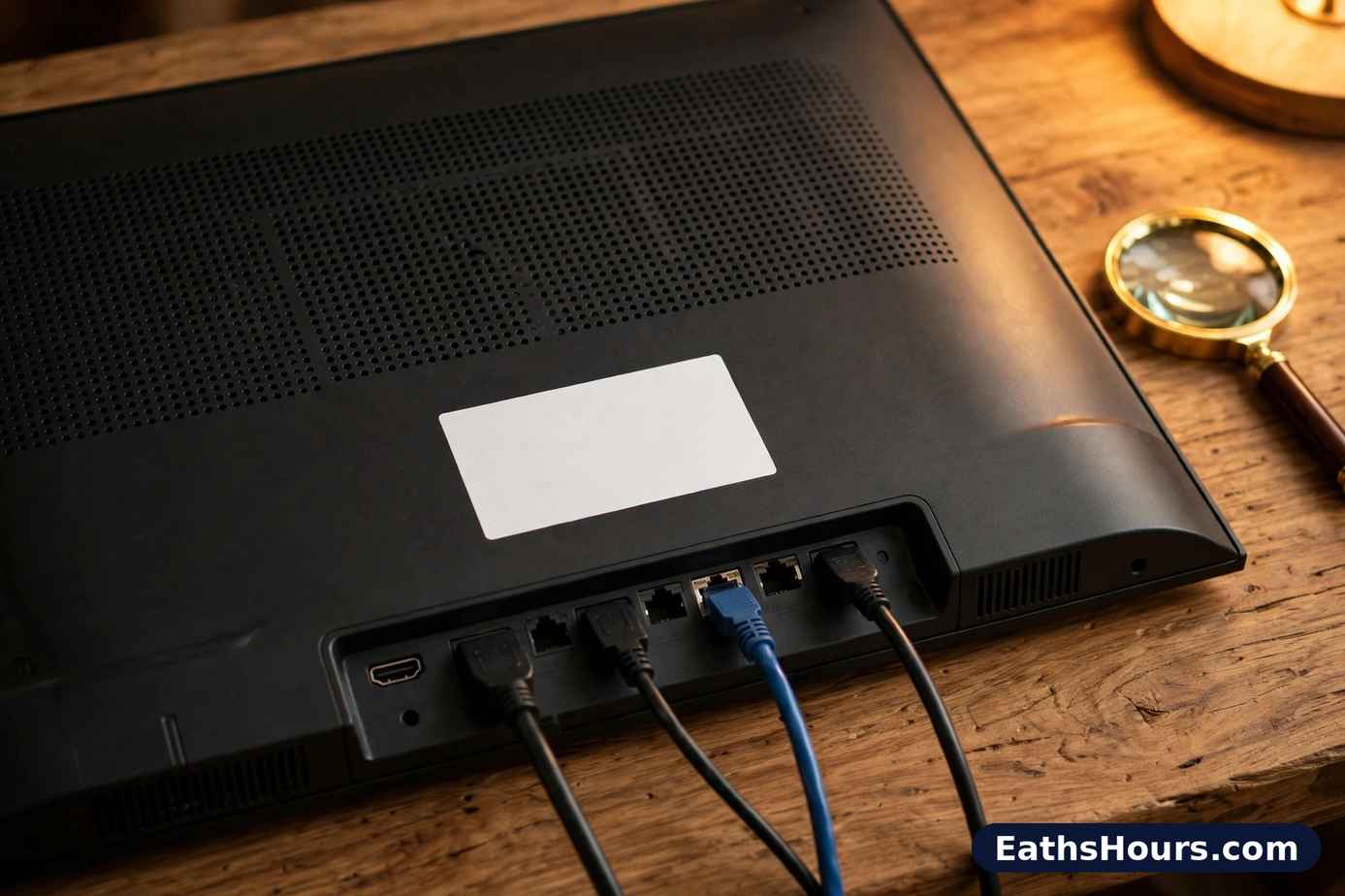
It adds that HDMI ARC and optical audio let the set “integrate into your home theater setup smoothly”. A port count is one of the most checkable claims a product page can make: ports are photographed in listings, diagrammed in manuals and listed in regulator filings. None of those records exists for this code — and the copies do not even keep the count: one describes four HDMI ports with HDMI 2.1 and eARC, the Samsung copies describe three HDMI 2.0 ports, the guide describes three of an unspecified version. Three guides, three different backs of the same television. What is consistent across all of them is the absence of the one artefact that would settle it — a photograph of the back of an actual unit, with a rating label on it.
Audio Experience
The guide rates the sound “quite decent for its price range”: 20W speakers “backed by Dolby Audio technology” delivering “clear dialogue and balanced tones”, with a soundbar recommended for deeper bass. The price range it refers to is never printed on the guide’s page, and the copies that do print one disagree by hundreds of dollars — so “decent for its price” is a judgement with no price attached. The 20W figure itself appears in no maker’s document; it is the wattage budget TVs most commonly carry, which is precisely why it proves nothing: it is the number a writer reaches for when describing the category, and other copies in the ecosystem quietly upgrade the same set to Dolby Digital Plus. Audio, like picture, is measured where a product exists — by reviewers with the unit in the room. No reviewer has had this unit in a room.
Pros and Cons: What You Should Know
The guide’s verdict section, kept in its own format. The pros and cons below are its claims about the product; the documented position — that no check could find the product — is stated once here rather than under each bullet:
✔️ Pros:
- Sharp 4K resolution with HDR support
- Multiple smart OS versions for flexibility
- Slim design with multiple size options
- Affordable pricing for its specs
- Good port selection and wireless features
❌ Cons:
- No HDMI 2.1 for advanced gaming
- Speaker system may lack bass for audiophiles
- Limited local dimming in dark scenes
Read closely, the list argues with itself and with the rest of the ecosystem. “Multiple smart OS versions” is listed as a pro — flexibility — where the smart section presents the same fact as a regional variation; in the record it is neither, it is two platforms attributed to one unidentifiable model. “No HDMI 2.1” is listed as a con here while another copy lists HDMI 2.1 with VRR as a headline feature of the same code. And “affordable pricing for its specs” rests on a price the guide never prints and no shop has ever charged. A pros-and-cons list is a summary of findings; here there were no findings to summarise, only a template to fill.
Who Should Buy the ZO35-G25DA74 Model TV’s?
The guide’s answer is anyone seeking “a smart 4K TV on a budget”, and it names its buyers:
- Students in dorm rooms
- Families upgrading from older HD TVs
- Guest rooms or secondary setups
- Streamers who want a seamless Android or Roku experience
The honest answer to the heading is shorter: nobody can buy it, because there is nowhere to buy it from. No retailer lists it, no marketplace seller can be identified, and no manufacturer’s store carries it. That is not a pedantic point — it is the practical one. A reader who goes looking for this model with money in hand will find only pages like the guide’s, and pages like the guide’s are where the risk sits: an unbranded listing, a marketplace seller using the code, a “deal” on a set whose maker, warranty and returns route do not exist. The students and families the guide addresses are exactly the buyers a phantom model can burn, because a television with no manufacturer has no warranty to claim and no support to call.
How to Check Any TV Model Code Before You Buy
The checks that produced this article take minutes and cost nothing, and they work on any model code a search result puts in front of you. Run them before paying for anything:
- Search the code on the manufacturer’s own site. Every real model has a product or support page with its maker. No maker page, no model — and if the guide never names the maker, that silence is itself the first finding.
- Test the code against the brand’s published format. Manufacturers document how their model codes are built; a code that cannot be parsed by its claimed brand’s own scheme — wrong opening letters, a size that doesn’t match, punctuation the brand never uses — is not that brand’s code.
- Check the regulator’s register. A TV with Wi-Fi or Bluetooth sold in the US carries an FCC ID and sits in a public grant database; TVs in the ENERGY STAR programme sit in a public certified-products list. Absence from both is a finding, not a gap in the paperwork.
- Look for the manual. Real models leave manuals everywhere — maker support libraries, manual archives, owner uploads. A model with no manual anywhere has, in all likelihood, never shipped.
- Demand the shop window. A real model can be bought from an identifiable seller with a returns policy. If every result for the code is a guide page and none is a listing, the code’s only existence is as content.
A model that passes these five checks may still disappoint — but it will at least exist, which is where buying has to start.
Comparison With Similar TVs
The guide compares its subject with “TCL and Hisense smart TVs in the same price bracket”, crediting it with “better HDR handling and a more intuitive UI”, conceding that it does not outperform “premium models like LG OLED or Samsung QLEDs”, and calling it “unbeatable value in the sub-$500 category”. Every rival named in that paragraph is real in the way this code is not: TCL, Hisense, LG and Samsung publish their models, price them in identifiable shops, submit them to reviewers and certify them with regulators. A comparison requires two sides, and only one side of this one can be produced. “Better HDR handling” than a TCL set is a measurement claim — against panels whose brightness figures are published — made for a panel no instrument has ever read.
One Code, Seven Televisions: The Guides Do Not Agree With Each Other
Line the guide pages up and the same code describes a different television on each. The guide this article answers describes a brandless LED set of 2024, Android TV or Roku, HDR10 and HLG, in sizes from 43 to 65 inches, under $500. Two other pages describe a Samsung QLED of 2021–2022 — Tizen, a Crystal Processor 4K, 60Hz, $600–800. A third describes a 2025 model with Android TV 12, Dolby Vision, a 120Hz native panel, Wi-Fi 6 and four HDMI ports with HDMI 2.1. Others describe sizes running from 35 inches, or up to 75; another prints a price of $299–349. Maker, year, panel, system, sizes and price — the copies disagree on every load-bearing fact a television has.
These are not seven views of one product; they are seven products sharing one string. A real model’s descriptions converge, because they all descend from one spec sheet. Descriptions of nothing diverge, because each writer must invent the whole set. One guide in the ecosystem deserves naming as the exception: a sceptical page that asked whether the model is “real or fake”, ran the retailer check itself, and concluded there is no official confirmation from any manufacturer and that the code does not match the naming formats of the major brands. That is, in shorter form, the finding of this article.
Final Thoughts About ZO35-G25DA74 Model TV
The guide closes by calling its subject “a reliable choice that won’t disappoint”, striking “a strong balance between affordability, smart features, and display quality”. On the record assembled here, the summary runs the other way. Asked about zo35-g25da74 model tv, the checks answer: there is no such television that anyone can point to. No manufacturer claims the code, and the one brand the copies assign it to does not list it, cannot parse it in its own published code scheme, and returns nothing when its own site is searched for it. There is no manual, no regulator grant, no certified-product entry and no shop listing — the four paper trails every real model leaves without trying.
What the code does have is a literature, and the literature is the tell: seven incompatible televisions, one injected hyperlink to an unrelated site, and prices quoted for a product no shop sells. If a set bearing this code is ever offered to you, judge it the way the checks judged the pages — ask for the maker’s name, the manual, the listing and the label on the back, where a real unit carries its model beside a unique serial number that its maker can trace. A television that cannot produce those four things is not a bargain. It is a description in search of a product, and descriptions do not come with warranties.
FAQs About ZO35-G25DA74 Model TV
What makes the ZO35-G25DA74 model TV stand out?
What stands out is the record around the code: no manufacturer claims it, no manual or regulator entry exists for it, and the guide pages describing it contradict each other on its maker, year, panel and price.
Does the ZO35-G25DA74 model TV’s support Bluetooth and Wi-Fi?
The guide says yes, but no check can confirm it — there is no verified product to carry a radio. A real Wi-Fi/Bluetooth TV sold in the US leaves a public FCC grant; none exists under this code.
Is the display quality on ZO35-G25DA74 model TV’s good for streaming?
It cannot be assessed: no panel has been published by a maker or measured by a reviewer, and the copies cannot agree on the basics — LED or QLED, HDR10/HLG or Dolby Vision, 60Hz or 120Hz.
Can gamers use the ZO35-G25DA74 for console gaming?
There is no verified television to connect a console to. The copies disagree even on the ports — three HDMI 2.0 in one version, four HDMI with 2.1 and VRR in another.
Is the ZO35-G25DA74 model TV’s easy to install?
There is nothing to install: no listing to buy from, no manual to follow, and the guide’s VESA claim comes from no maker’s document. Judge any seller using this code by the checks in this article first.