Listen to Music or Listen to the Music: Which One Should You Say?
Type listen to music or listen to the music into a search box and both versions look right — because both of them are. Each simply answers a different question: one talks about music as an activity, the other points at a particular sound.
The difference is carried by one small word. Music with nothing in front of it names the art itself — the habit, the taste, the pleasure. Put the in front of it, and it names one stretch of sound that the people talking can both identify.
What follows settles the pair for good: why music refuses a plural, when the is earned, why the radio breaks the pattern, and the one test that picks the right form in any sentence. The pair listen to music or listen to the music is decided by reach, not by taste.

Quick Answer
Say listen to music for the activity in general: “She listens to music on her morning walk.” Say listen to the music for one identified sound: “Listen to the music drifting over the fence.” If the music cannot be pointed at, leave the out.
The Verdict in One Table
The whole choice fits on one small table. Keep it beside the examples that follow and the pattern will start to feel automatic.
| You mean | Say | Example |
|---|---|---|
| Music in general — a habit, a taste, the art | listen to music | “He listens to music while he works.” |
| One identified sound, known to both people | listen to the music | “We replayed the music from the wedding video.” |
| The sound playing around you right now | listen to the music | “Turn the music down, please.” |
Why “Music” Stands Bare: It Cannot Be Counted
Start with the noun, because the noun decides everything. Dictionaries enter music as uncountable: it names the art as one whole substance, the way water and information name theirs. Nobody slices it into numbered units.
That single fact closes two doors at once. A cannot stand in front of an uncountable noun, and a plural ending cannot hang on one either — so everyday English has no a music and no musics for the art.
Counting is still possible; it just runs through a countable neighbour. English counts a kind of music and, for single works, a piece of music or two pieces of music — the counter changes, and music itself stays whole.
When “Listen to Music” Is the Right Form
Use the bare form whenever the sentence is about the activity rather than about any particular sound. Habits, tastes and routines all live here, because none of them points at one performance or recording.
- “I listen to music every morning.” — a routine that stays true on any day of the year.
- “He listens to music while he cooks.” — the activity fills the kitchen, whichever songs are on.
- “They listen to music together in the car.” — the shared pastime, not one named playlist.
Notice what the bare form never promises: a title, a performer, a moment. If a sentence would stay true with every song swapped for another, the bare form is doing its job.
When “Listen to the Music” Is the Right Form
Add the when the music has been identified — by the room, by an earlier mention, or by a phrase that pins it down. The word tells the listener: you know the one I mean.
- “Listen to the music — hear how the drums drive it?” — the sound is playing now, and both people can hear it.
- “We still talk about the music at their wedding.” — one remembered performance, shared by everyone in the conversation.
- “She wrote the music for the film.” — one identified body of work, attached to one film.
A reliable signal hides in the tail of the sentence. When a phrase after music says which music — at a wedding, in this scene, from the film — then the belongs in front of the noun.
The “To” Is Not Optional
A shorter mistake hides inside the longer one. Listen never takes its object directly; the word to has to carry the sentence across — to a teacher, to the radio, to music itself. Without that bridge, the verb never arrives.
Drop the to and no article choice can rescue the sentence. “Listen music” fails, and “listening music” fails the same way — the -ing ending changes the verb’s shape, never its needs.
Why the Radio Keeps Its “The”
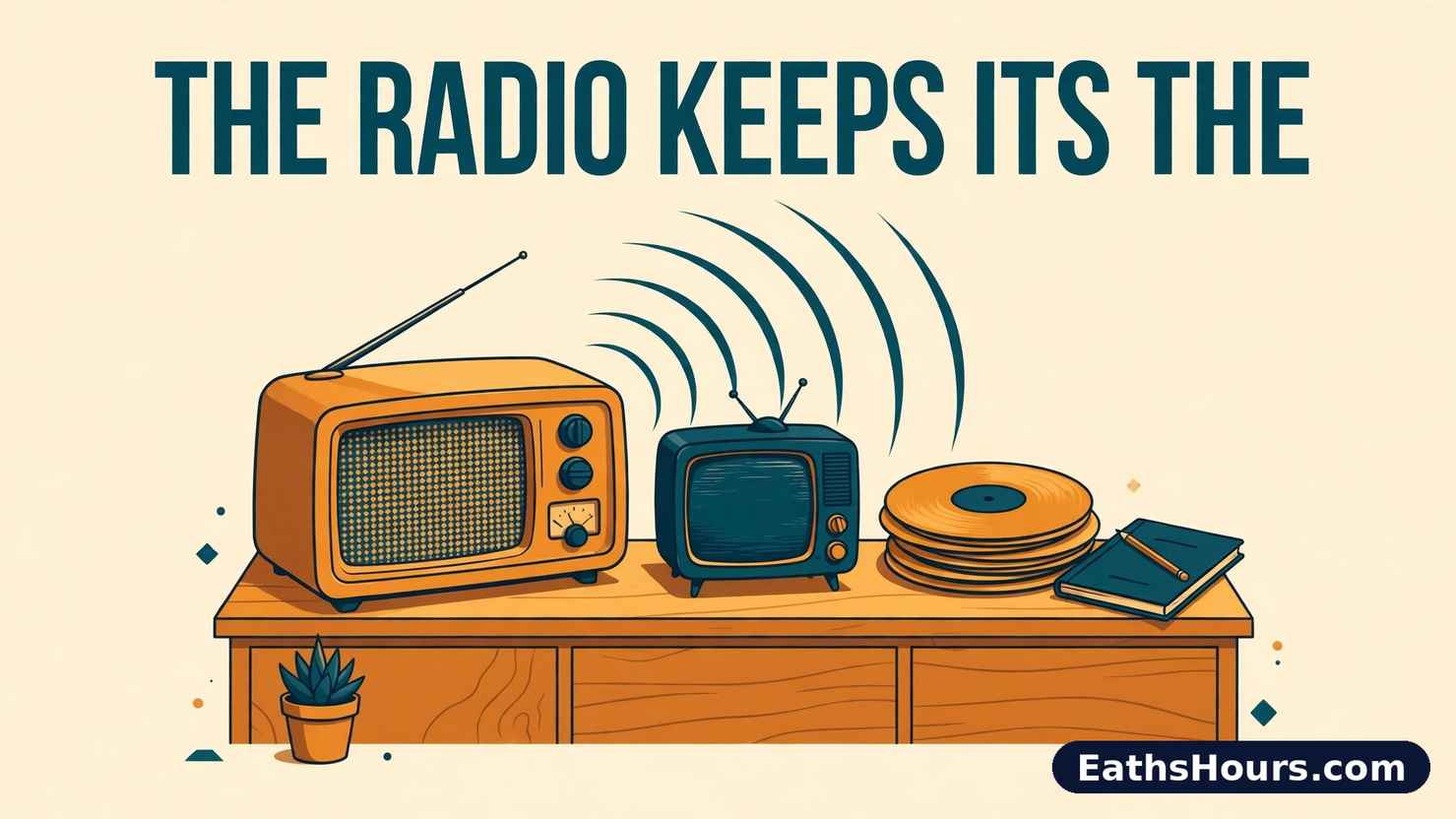
One neighbour breaks the pattern instead, and it catches learners daily. Talk about the broadcast medium in general and English still says listen to the radio — the survives even when no particular set is meant.
The reason is family, not logic. Radio sits among the everyday fixtures of life — the newspaper, the phone, the train — that English treats as institutions and dresses with the as a matter of habit.
Television settled the other way: as an activity, the medium takes no article at all — “You watch too much television.” Two sound media, two different settlements — each word simply keeps the company it grew up in.
A Five-Second Test Before You Speak
When a sentence could go either way, ask one question: could the listener point at the music I mean? If yes — it is playing, it was just mentioned, it lives in a shared memory — the earns its place.
If the answer is no, no particular sound exists yet — the sentence is about an idea, not a thing anyone can hear. Ideas stand bare: say music, and let the sentence talk about the activity, the taste or the habit.
And when the doubt is only about habit, choose the bare form. Most daily talk about music is general talk, so the bare form is the safer default — until the moment a particular sound enters the room.
Frequently Asked Questions
Is “listen to music” right in every sentence?
No. It is correct for music in general — habits, tastes, routines. The moment one identified sound is meant, the form changes: “Listen to the music playing next door” points at a sound both people can hear.
Can I say “a music”?
Not for the art itself. Music is uncountable, so English reaches for a countable neighbour: “a kind of music” names a style, and “a piece of music” names a single work. Everyday English avoids “a music” entirely.
Why is it “listen to the radio” but “listen to music”?
Because the two words settled differently. Radio names an everyday institution, and institutions keep the in English; music names an uncountable art, and general statements about it stand bare. The dictionaries print both habits side by side.
Is “listening music” ever right?
No. Listening still needs its bridge word: “listening to music” is the only form, in questions, statements and titles alike. Dropping the to breaks the sentence whichever article follows it.
How do I say it about one song at a wedding?
Use the: “the music at the wedding” names one identified body of sound. The phrase after music does the identifying, and identified music always carries the in front of it.
Conclusion
The pair listen to music or listen to the music is decided by reach, not by taste. Bare music covers the art; the music covers one identified stretch of it, and the listener always knows which world the sentence is in.
That is the whole system: keep the to, leave general music bare, and let the step forward when a particular sound is meant. The fuller walk-through at Gimme Meaning collects the same kind of choice across everyday pairs.
One last frame is worth keeping beside the pair: the uncountable noun, the family music belongs to — the class of nouns English refuses to count directly, from information to furniture.