Russian Brick Incident: The Death the Profile Retells as a Survival
Search for the russian brick incident today and the top explainers describe a lucky escape: a brick bursts off a truck somewhere in Russia, punches through a windscreen, and the woman it hits — unnamed, undated, unplaced — survives her head injury after emergency treatment. The best-ranking guide gives the event no city, no surname and no ending worse than a recovery, and illustrates it with two photographs of a war it never mentions.
The occurrence behind the phrase was a death, and it was documented while it was still news. In the summer of 2012 a Rostov-region newsroom reported the crash the week it happened, naming the road, the hospital and the police colonel who spoke about it: a brick out of an oncoming KamAZ, a 29-year-old passenger struck in the temple, a hospital in Azov, a life ended two hours later. The recording that made the crash famous survives in a public media archive, its catalogue entry carrying the same names and the same outcome.
So the audit below sets the viral profile against the contemporary record, item by item. Where the guide is right, the table says so. Where it is wrong — and it is wrong about the one fact that matters most, whether the woman lived — the record is quoted at full strength and the guide’s version is left where it belongs, in the census of claims. This page neither links to nor embeds the footage: it records a real woman’s death, and a reader who needs it can find the archive copy without this page’s help.
The Checks: What the Record Actually Shows
A viral-event profile can be tested the way any other profile in this run has been tested: against the records that were created before the retelling began. The same approach has already been applied to a model number that exists nowhere outside the profiles written about it, a significance claim hung on a word nobody can define and a storefront measured against its own empty shelves — in each case the early document outweighed the later literature. Here the early documents are three. First, a contemporary report from 161auto, a Rostov motoring newsroom, written while police were still commenting: it names the highway, the kilometre, the hospital and the officer. Second, a Turkish wire item in Sabah dated 15 June 2012, which carried the death abroad within the same news cycle. Third, the recording itself, preserved in the Wikimedia Commons media archive under the file name “Russian Brick accident June 2012”, whose catalogue description repeats the names and the outcome, and whose own clock can still be read in the frame.
Set against those three, the guide’s account fails at its centre and frays at most of its edges. It preserves the shape of the event — a brick, a truck, a windscreen, a Russian highway — and loses nearly every particular that the contemporary record supplies, including the particular that decides what kind of story this is.
| His claim | What he prints | What the record shows |
|---|---|---|
| The date | “Believed to be around early 2012–2014” | The 11th, in 2012. The recording’s own clock and the Commons catalogue read Friday 11 May, about 10:25; the contemporary Rostov report says Monday 11 June, about 11:00. The month is disputed between the two earliest records; the copies’ “August 12” appears in neither. |
| The place | “Russia (Exact city unknown)” | The 11th kilometre of the Azov–Starominskaya highway, Azov district, Rostov Region — named in the contemporary report. |
| The truck | Table: “Loose brick from oncoming truck”; body: “a poorly secured truck ahead” | Oncoming. A loaded KamAZ carrying bricks, last in a group of vehicles in the opposite lane. His table is right; his own body text contradicts it. |
| The camera | The brick “smashes into the windshield of the vehicle recording the incident” | The recording was made from a car travelling behind the struck car, which stays in frame ahead of the camera. The brick never touched the camera car. |
| The people | “Unnamed driver, passenger” | Named within days: Olga Gaikovich, 29, of Syktyvkar, the front passenger. Her husband was driving; his brother, his brother’s wife and their child were in the car. None of them was injured. |
| The outcome | “Passenger sustained head trauma”; “she survived the ordeal after receiving emergency treatment” | She died. The brick struck her right temple; she was taken to the hospital in Azov and died about two hours later. The guide’s central claim reverses the record. |
| The authentication | The footage “has been authenticated by multiple sources”; “frame-by-frame breakdowns confirmed the event’s authenticity” | No source is named for either assertion. The event’s reality rests on the contemporary police-quoting report — which the guide does not cite. |
| Responsibility | The truck driver “has never been publicly identified”; “no official legal report has been publicly linked to the video” | The driver is indeed unnamed in the record. But police found the truck in Aksai, and the regional police press chief said on the record that the unsecured load was being examined as possible criminal negligence. No outcome of that inspection was found in the sources consulted. |
| His photographs | Two images presented as illustrations of the incident | Neither shows it. Both are photographs of war damage in Ukraine — a man standing over missile wreckage; firefighters inside a bombed building — a different country, a later war, no road, no car, no brick. |
| His evidence | The keyphrase in his introduction links out to a BBC News story | The destination sits in the BBC’s England–London section — a London story. Whatever it reports, it is not this incident, and it documents nothing about Rostov. |
The pattern is worth naming at the outset. The guide was not written from the record; it was written from the video’s reputation. Everything the record knows and the reputation forgot — the name, the town, the death — is missing from it, and everything the reputation added — the survival, the authentication, the frame-by-frame breakdowns — is asserted without a source. The sections that follow take his headings in his order and answer each one from the documents above.
Profile Biography Table
His page opens its evidence with an eight-row table, reproduced here exactly as he prints it:
| Attribute | Details |
|---|---|
| Incident Name | Russian Brick Incident |
| Date of Occurrence | Believed to be around early 2012–2014 |
| Location | Russia (Exact city unknown) |
| Format | Dashcam Video (Viral Clip) |
| Involved Parties | Unnamed driver, passenger |
| Object in Question | Loose brick from oncoming truck |
| Outcome | Passenger sustained head trauma |
| Internet Status | Viral Meme / Shock Video |
Read as a summary of the record, the table fails in an instructive order. Its most confident row is its most accurate: the object did come from an oncoming truck — a detail his own body text then contradicts by moving the truck ahead of the car. Its vaguest rows are vague where the record is precise: the date was published to the day in 2012, and the location to the kilometre. Its “Involved Parties” row withholds names that were in print within the week. And its “Outcome” row performs the table’s quietest and largest edit: “Passenger sustained head trauma” is, word by word, true — she did sustain head trauma — and it is arranged to let a reader finish the table believing the story ends there. It does not. The trauma is what she died of, about two hours after it was inflicted, and a table that prints the injury while omitting the death has not summarised the incident; it has replaced it.
What Is the Russian Brick Incident?
Stripped of its retellings, the phrase names a real and narrow thing: a fatal road accident in Russia’s Rostov Region in 2012, in which a brick escaped from a loaded KamAZ travelling in the opposite direction, crossed into an Audi A4 coming the other way, pierced its windscreen and struck the front-seat passenger — and the dashcam recording of those seconds, made from a car travelling behind the Audi, which carried the event around the world for more than a decade afterward.
Both halves of that definition matter. The accident is a documented event with named participants, a named road and a police statement attached. The recording is a separate artefact with its own history: filmed that morning, spread through the video sites of the early 2010s, famous enough by 2021 for its disappearance from a defunct platform to be mourned in public, and preserved today in a media archive under a catalogue description written from the same contemporary reporting. The guide treats the two halves as one blur — a video whose contents he narrates loosely and whose subject he never quite identifies. Keeping them separate is what allows each of his claims to be checked: the accident against the news record, the recording against the archive copy.
The Documented Record: A Seaside Drive in the Rostov Region
The contemporary account is a Rostov motoring newsroom’s report, headlined “Кирпич-убийца” — “The Killer Brick” — and it is built the way regional news is built: from the police statement outward. A young couple from Syktyvkar had set out on a seaside holiday, travelling in an Audi A4 with friends — a second couple, with their child. On a Monday morning in 2012, at about eleven o’clock, they were passing the eleventh kilometre of the Azov–Starominskaya highway in the Azov district when a group of vehicles came the other way, the last of them a KamAZ loaded with bricks.
One brick came off that load. The report is exact about the geometry: it struck the windscreen squarely, went through it, and hit the 29-year-old front passenger in the right temple. The nearest traffic-police crew reached the scene in eight minutes. She was taken to the Azov central district hospital, where the head injury proved too serious; she died about two hours after the impact. Nobody else in the Audi was hurt — not her husband at the wheel, not the couple behind, not the child.
The KamAZ driver never knew. He drove on without stopping, and police found the truck in the city of Aksai. The statement the report carries is from Colonel Alexey Polyansky, head of the press service of the Rostov Region’s Main Directorate of the Interior Ministry, and it is quoted here because the guide’s responsibility section proceeds as if no official ever spoke: the police, Polyansky said, did not intend to treat the matter as simply an accident; it might amount to the criminal negligence of the KamAZ driver, who had not ensured the reliable securing of the cargo he was carrying; an inspection was under way, and a procedural decision would follow on its results. A Turkish newspaper, Sabah, carried the same death abroad on 15 June 2012 — the brick flying “like a cannonball”, the woman named as Olga Gaykovich, 29 — which fixes the story in the international record inside the same news cycle.
Two wrinkles in the documents deserve print rather than smoothing. The first is the month. The regional report dates the crash to Monday 11 June; the recording’s own timestamp, still legible in the archived copy, reads 11 May 2012 at 10:24 in the morning, and the Commons catalogue follows the camera: Friday 11 May, at about 10:25. Both dates cannot be right, and this article makes no pretence of settling them: the day of the month, the late-morning hour and the year agree across every early source, the month does not, and dashcam clocks are fallible instruments. What can be said firmly is that no early record supports the “August 12” that the later copies print, and none supports the guide’s three-year shrug of “early 2012–2014”. The second wrinkle is smaller: the Commons description has the driver “stopped by the police in Azov”, where the regional report has the truck found in Aksai, a different town in the same region. The catalogue was written a decade later, from the reporting; where the two differ, the contemporary report is the one written while the police were still answering questions.
How Did the Russian Brick Incident Happen?
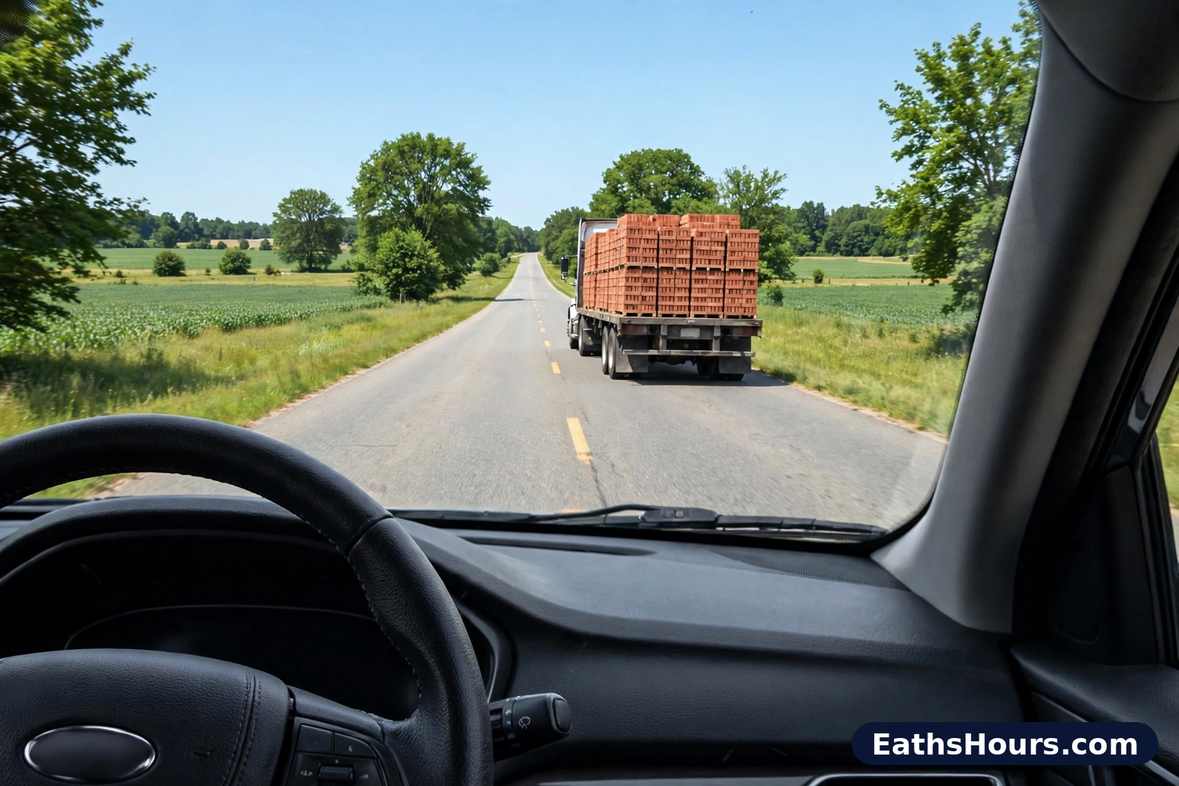
His version has the brick dislodge from “a poorly secured truck ahead” and strike the car carrying the camera. The record supports neither half. The KamAZ was not ahead of the Audi; it was coming toward it, in the opposite lane, at the tail of a group of oncoming vehicles — which is why the closing speed was the two vehicles’ speeds added together, and why nobody in the Audi had time to do anything at all. And the camera was not in the struck car. The archived recording opens that morning with the camera car parked by a brick building, then follows the Audi along the highway with the Audi in frame ahead; the brick crosses the frame, the Audi’s windscreen bursts, and the camera car — untouched — pulls up behind it. A recording made inside the Audi could not show the Audi. His sentence relocates both the truck and the camera, and in doing so quietly converts a witnessed death into a survived scare: if the brick had hit the car whose occupants were filming and talking, the story he tells afterward would be theirs to tell. It was not, and it is not.
The record supplies no mechanism finer than that. No early source says whether the brick fell from the top of the load, worked loose from a stack, or was thrown up from the road surface by the truck’s own wheels; the regional report says only that it flew from the KamAZ, and the police statement frames the question as one of securing: the load, the colonel said, had not been reliably fastened. Retellings that add a bounce, a trajectory or a speed are decorating a gap. The honest sentence is the short one: a brick left a loaded truck at highway speed, and a woman in the oncoming car was in its path.
The Aftermath: Injury and Recovery
This is the heading under which the guide performs its largest act of fiction, and it must be answered plainly. He writes that “initial reports based on video descriptions claimed the woman sustained serious head trauma”, but that “internet investigators and follow-up discussions suggest that while the injuries were severe, the passenger survived the ordeal after receiving emergency treatment”. There were no such initial reports, and there is no such suggestion in any document this audit could find. The initial report — the contemporary one, sourced to the police — records a death: the Azov hospital, the injury too serious, the end about two hours later. The Turkish wire item records a death. The archive catalogue records a death. The later copies that name her record a death. The survival exists in exactly one place, which is his page, attributed to investigators and discussions he does not name, link or quote.
Notice the machinery, because it recurs across this literature. A documented outcome is first demoted to a “claim” (“initial reports… claimed”), then overturned by an unnamed consensus (“internet investigators… suggest”), and the reader is left with the overturning as the takeaway. Applied to an invented platform, the trick costs a reader some money at worst. Applied here, it unmakes a death: Olga Gaikovich, who was twenty-nine and on her way to the sea, is presented to everyone who searches her worst moment as a woman who got up from it. She did not. The aftermath section of the record contains a hospital, a two-hour interval, and a family driving home one person short — and after that, in the sources consulted, silence: no follow-up reporting on the family was found, and none is invented here.
Why Did the Video Go Viral?
On this heading the guide is broadly right, and the audit can afford to say so. The recording has the properties that made early-2010s dashcam footage travel: it is short in its circulating form, it is unstageable-looking in the way only an ordinary morning can be, its catastrophe arrives without warning in the middle of banality, and it asks the viewer a question — could I have done anything? — to which the honest answer is no. Russia’s dashcam density did the rest: a country where a large share of cars carried cameras produced a genre, and this recording became one of its defining exhibits, filed by viewers alongside meteor footage and near-miss compilations as proof of what the cameras were for.
Two corrections of emphasis belong here. First, the guide’s claim that the video “exploded” as a meme flattens its actual afterlife: its fame was always of the grim variety — it circulated as a shock clip and a cautionary tale, was remembered on a major forum years later specifically as the video that taught a commenter “not to ever take the people I love for granted”, and was mourned as lost when LiveLeak closed in 2021. Second, virality is the guide’s alibi for everything else on his page: because the clip is famous, its subject is treated as folklore, available for rearrangement. The record shows the opposite relationship. The clip is famous; the event is documented; the fame does not dissolve the documentation.
Cultural Impact and Online Discussions
His culture section lists driver-safety awareness, load securing and “the randomness of life-threatening events”, and adds that the incident became a byword for sudden misfortune, “much like ‘Final Destination’ scenarios”. The safety half of that is real enough: the recording has been used for years, in discussions this audit read, exactly as a cargo-securing parable — the one-brick version of the lesson every haulage manual teaches. The meme half is where his account again drifts from the record. The discussions that survive do not treat the clip as a joke format; they treat it as the genre’s memento mori, the clip people cite when the compilation stops being funny. Where later content farms did try to convert it into content — decks and explainers with the death intact but the facts scrambled, hashtags asserted rather than shown — that is not the incident’s cultural impact. It is the impact of the industry that grew up around it, and it is censused separately below.
One genuine cultural fact stands in the record: the clip helped fix, for an international audience, the image of the Russian dashcam itself — the ever-present witness that made the country’s roads legible to outsiders. A camera culture built for insurance disputes and corrupt checkpoints ended up preserving, among thousands of curiosities, a complete and unbearable piece of evidence. The guide’s dashcam section takes up that theme below; here it is enough to register that the recording’s cultural weight comes precisely from its being evidence — the property his retelling spends the most effort dissolving.
One Death, Many Endings: The Copies Compared
His is not the only retelling, and comparing the family is the quickest way to see what each writer did with the same documents. The copies divide into two houses. In one, she dies: a SlideServe deck under the name “folktalestories” (August 2025) names Olga Gaikovich and gives her death correctly — then decorates it, dating the crash to an August 12 that no early source contains, crediting the incident with “significant reforms in Russian transportation regulations” that no source documents, and reporting that her husband “sustained significant injuries” when the record says nobody else was hurt. A NaijaWorld post (July 2024), reproducing a Voice of Article explainer, also keeps the death and the wrong August date, and novelises around them: an appointment she was supposedly travelling to, an intersection, a truck taking “a sharp turn”, hashtags said to have trended. The Voice of Article text itself cannot decide whether she died at all — “severe injuries to the driver”, “may have caused death” — and credits its picture to a newspaper, The Sun, like a rumour citing a rumour.
In the other house — his — she lives. The difference could hardly be larger. Every other error in the family is an error of detail: a month, a mechanism, an embellished reform. His is an error of outcome, and it runs in the direction this literature always prefers, because a survivor is a safer product than a corpse: the page can be shocked, moved and reassured in a single sitting, and nobody has to sit with the fact that the famous clip ends, two hours after its final frame, in a hospital in Azov. Set beside the copies that kept the death and merely scrambled its circumstances, his version is the family’s outlier — the one that read the record, or failed to, and chose the ending the record refuses.
Was the Russian Brick Incident Real?
Yes — and the guide’s route to that answer is worth correcting even though the answer is right. He writes that the footage “has been authenticated by multiple sources” and that “frame-by-frame breakdowns confirmed the event’s authenticity”, naming neither the sources nor the breakdowns. The event does not need them. It was reported as news, by a regional newsroom, in the week it happened, with a named police press officer describing the load-securing question in terms no publicist would invent; it was carried abroad by a Turkish daily within the same cycle; and the recording that survives matches that reporting point for point — the road, the truck, the car, the hour on its own clock. Authentication, for an event with a police statement attached, is not a property conferred by video analysts. It is what the contemporary record already is.
The doubt his section answers is real but misplaced. Viewers did ask, over the years, whether so violent a clip could be genuine — the question attaches to almost every famous dashcam recording — and the honest answer is the one the documents give: the crash predates the tools and the incentives of the modern fake, it left a paper trail in two countries, and the woman in it has a name that appears in print in June 2012, in a report that describes her dying. A staged video does not generate a police colonel.
Was Anyone Held Responsible?
His answer — that the truck driver “has never been publicly identified” and that “no official legal report has been publicly linked to the video” — is half a record wearing a full one’s clothes. The unnamed part holds: no source consulted names the KamAZ driver, and this article will not go looking for him. But the official record is not the blank he describes. Police found the truck in Aksai. The regional force’s press chief stated, for publication, that the matter would not be treated as a simple accident, that it might constitute the driver’s criminal negligence in failing to secure his load, and that an inspection was under way whose results would produce a procedural decision. That is an official position, publicly stated, at the time — the reverse of his shrug.
What followed the inspection is where the record genuinely runs out. No verdict, charge or closure was found in the sources consulted for this article — not in the regional reporting, not in the copies, not in the archive catalogue — and the gap is recorded here as a gap, at exactly that strength. A reader should hold the two halves separately: responsibility was officially contemplated, in print, in 2012; its outcome is undocumented in everything this audit could reach. The guide collapses both halves into “unresolved”, which has the convenient effect of making his page’s silence look like the world’s.
The Role of Dashcams in Russian Road Culture
His background section is the page’s most conventional, and mostly survives contact with the record: dashcams were indeed widespread in Russia by 2012, carried against insurance fraud, disputed blame and roadside extortion, and they made the country’s driving an open archive in a way no other nation’s was. The Wikipedia summary of the phenomenon says the same in a sentence — the cameras spread as a guard against police corruption and insurance fraud, supplying evidence where testimony was cheap. This recording is the extreme case of that logic: a camera bought for petty disputes captured a killing that its own car’s occupants merely witnessed, and the footage became the event’s chief public document — more durable than the news report, which survives in a forum’s quotation, and more travelled than the police statement, which survives inside it.
Two details from the artefact itself deserve a place in this section. The camera that recorded the crash was an iconBIT unit, its brand burned into the corner of the frame — a consumer gadget doing, accidentally, the work of a court exhibit. And its clock, as noted above, reads a different month from the news report’s, a small permanent warning attached to the most famous piece of dashcam evidence of its era: the camera records everything except, reliably, when it is.
Conspiracy Theories and Misinformation
His section reports that some viewers called the incident staged, others that it was “AI-generated or deepfaked”, and that breakdowns refuted them. The staging doubt is at least period-appropriate — it was asked of famous dashcam clips throughout the 2010s, and the contemporary record answers it above. The AI claim is an anachronism wearing a heading: the recording was made in 2012, years before generative video existed as a public capability, and no named person is quoted making the claim. Its presence on the page is template furniture — the same paragraph, with the nouns changed, that this literature now pastes under every viral artefact — and its function is worth seeing clearly: a page that has itself rewritten the event’s outcome positions itself as the referee of other people’s misinformation.
The actual misinformation in this story is not conspiratorial and never needed a theory. It is the slow, commercial kind: a date moved to August, a husband promoted to injured, reforms invented, hashtags asserted, and, on the page under audit, a death converted to a recovery by unnamed investigators. None of it required a hoaxer. It required only writers who found the record less usable than the rumour, and a format that never asks them for a source.
Psychological and Emotional Reactions
His list — nervousness about driving behind trucks, unease about random accidents, distress from repeated viewing — is presented as the reported experience of “many online viewers”, without a single viewer quoted. The underlying phenomenon is not invented: the surviving discussion of this clip is unusually sombre for its genre, and the recollections this audit read — viewers describing the clip years later as the one that changed how they drive, or how they say goodbye — support the direction of his list if not its wording. What the record will not support is the clinical register. No study of this recording’s viewers was found, no survey exists to cite, and “trauma” as he uses it is a genre word, not a finding.
A plainer point sits underneath his section, and it belongs to the record rather than to psychology. The person most entitled to a reaction is not in his article at all. A family from Syktyvkar took a holiday drive in 2012 and came home without its wife, mother and friend, and then watched the worst seconds of their lives become a permanent exhibit of the early internet — misdated, misdescribed, and in his version, denied. Whatever viewers feel about the clip, it is worth remembering that for four of the people in the frame it is not content.
Safety Lessons from the Russian Brick Incident
His lessons — secure cargo properly, use dashcams, keep distance from trucks, wear seatbelts — are the standard four, and three of them deserve to stand, with the record’s corrections attached. The load lesson is the incident’s own: the police statement of 2012 is, at bottom, a load-securing document, and the colonel’s phrase for the failure — the driver “did not ensure the reliable securing of the cargo” — remains the most precise sentence anyone has written about why Olga Gaikovich died. The distance lesson needs its geometry corrected: the brick came from the oncoming lane, where following distance is meaningless; the applicable habits are the duller ones — attention to the state of oncoming loads, and an instinctive flinch away from any truck shedding debris, in either direction. The dashcam lesson is the one the event teaches best, though not as he frames it: the camera did not protect anyone in the Audi. What it did was testify — it made the event undeniable, attributable and permanent, which is why a guide written thirteen years later can be audited at all.
The seatbelt lesson, finally, is his list’s filler: nothing in the record suggests a belt was at issue in a through-windscreen strike to the temple, and its inclusion shows the list being completed rather than considered. The real curriculum of the incident is shorter and harder: loads kill at a distance, the law knew it in 2012 and said so, and the only person who could have prevented this death was the one who loaded, or failed to secure, a KamAZ in the Rostov Region — a man whose name the record never printed and whose inspection’s outcome it never reported.
Where Can You Watch the Video?
His answer names Reddit, YouTube and LiveLeak, with a note that LiveLeak closed before his page was written. The census, at the strength the documents support: short versions of the clip have circulated on the ordinary video platforms since 2012 and still do; the platform most associated with its fame, LiveLeak, shut down in May 2021, and the clip’s afterlife there survives in viewers’ recollections; and the fullest copy — five minutes, opening on that morning’s ordinary beginnings — is preserved in the Wikimedia Commons media archive, imported there in 2023 from a shock-video site, which is where this audit examined it. That provenance is recorded deliberately. The recording reached the public archive by way of the gore economy, and any honest account of where it lives has to say so.
This article does not embed the footage, link to it, or describe its worst frames, and the reason is the whole article: the video is not a stunt, a prank or a near-miss. It is the record of the last conscious minutes of a named woman’s life, taken without her knowledge by strangers in the car behind. A reader who needs it for a genuine purpose — research, teaching, the audit of some other retelling — now knows the archive that holds it. A reader who only wants to watch a stranger die has been told, instead, who she was.
How to Check a Viral Video Before You Repeat It
The tests that produced this article are portable, and none of them takes an evening:
- Find the first report, not the loudest one. Viral events that are real were usually news before they were content. A regional report written in the week of the event outweighs a decade of explainers; here it supplied the road, the hospital and the police position in a single page.
- Read the artefact’s own furniture. The archived recording carries its clock in the frame and its catalogue history in the open. The clock settled the hour, disputed the month and identified the camera’s make — three facts no retelling mentioned.
- Check whether the subject has a name. An unnamed victim in a profile of a famous event is a warning light: names are the first thing real reporting produces and the first thing content drops. The moment this event’s passenger is named, her outcome is checkable — which is precisely why the survival version keeps her anonymous.
- Watch for the demotion move. When a profile calls a documented fact an “initial claim” and overturns it with unnamed investigators, discussions or breakdowns, the burden has not been met — it has been hidden. Ask who, specifically, is said to know better, and notice when nobody is.
- Look at the pictures. Illustrations in this literature are frequently borrowed from other events entirely. His page illustrates a 2012 highway death with photographs of a later war; thirty seconds of looking is enough to catch it, and nobody in his production chain spent them.
- Follow the evidence link. A profile’s one outbound citation is its character reference. His keyphrase links to a BBC story filed under London; the click that was supposed to establish his authority establishes instead that the link was placed for the search engine, not the reader.
Run on a classroom package whose seller’s own listing said less than its brochure, the same six tests ended in the same place: the earliest document in the chain outweighed everything written after it. The documents are public, the tests are quick, and the only cost is the one this literature exists to avoid — reading the record before repeating the story.
Final Thoughts on the Russian Brick Incident
His closing calls the incident “more than just a viral video” — a lesson in how fragile life is, and in why road safety matters — and on the sentiment, if not the record, there is little to quarrel with. But a conclusion is where a page shows what it thinks it has been describing, and his has been describing a different event from the one in the documents: undated where the record is dated, unplaced where the record is placed, anonymous where the record is named, and survived where the record is fatal. The fragility his conclusion praises is real precisely because the outcome was the one he removed. A brick weighing a few kilograms, one unsecured load, one oncoming lane — and a twenty-nine-year-old’s life ended between a traffic-police crew’s eight-minute drive and a hospital’s two-hour effort. There is no version of that story in which she recovers, and the record’s refusal to provide one is not a missing piece of the story. It is the story.
What generalises is the discipline, not the grief. The internet’s memory of this event was written twice: once by a Rostov newsroom in the week it happened, and once by the content industry across the following decade, and the two memories share almost nothing but a brick. The first is shorter, sadder and sourced. The second is longer, vaguer and — in the guide the search results lead with — wrong about whether its subject lived or died. Between those two memories, a reader’s obligation is not complicated, and neither is this page’s: the dashcam in the car behind did its work perfectly in 2012, preserving exactly what happened for anyone who cares to look. The least a retelling owes that record is to look.
FAQs About the Russian Brick Incident
Q1: What is the Russian Brick Incident?
A fatal road accident in Russia’s Rostov Region in 2012 — a brick off an oncoming KamAZ pierced an Audi A4’s windscreen and killed its front passenger — and the dashcam recording of it, filmed from the car behind, that circulated worldwide for a decade.
Q2: Is the Russian Brick Incident video real?
Yes. The crash was reported contemporaneously by a Rostov newsroom with a named police press officer, and carried abroad by a Turkish daily in June 2012; the archived recording matches that reporting. No “authentication” by unnamed sources is needed or offered.
Q3: Did the woman in the video survive?
No. Olga Gaikovich, 29, of Syktyvkar, was struck in the right temple and died at the hospital in Azov about two hours later. The survival story appears only in the guide under audit, attributed to unnamed “internet investigators”.
Q4: Was anyone held accountable?
Not in any document this audit could find. Police found the truck in Aksai, and the regional police press chief said the unsecured load was being examined as possible criminal negligence; no outcome of that inspection was found in the sources consulted.
Q5: Why did this video become so famous?
It is the defining exhibit of Russia’s dashcam era: an ordinary morning, a catastrophe without warning, and a camera that happened to be running behind the struck car — famous as a cautionary tale about unsecured loads, not as a near-miss with a happy ending.