Pencil Drawing for the Armed Forces of Ukraine: The Guide, the Practice and the Craft
A pencil drawing for the Armed Forces of Ukraine is exactly what the phrase says: a picture drawn by hand, in pencil, for the country’s defenders — most often by a child, and most often carrying a flag, a sunflower and a few words of thanks. The Ukrainian page that answers the search is a how-to guide: which elements to include, how to prepare, four steps to follow, and how the finished sheet is meant to travel from a school desk towards the front.
Guides of this kind are easy to write past the evidence, because the subject is moving. This article keeps two things apart. The first is the guide itself — its sixteen sections are followed here in their own order, in English, with its steps and tips carried whole. The second is the record around it: the drives, collections and exhibitions that news reports and museum pages document, against which the guide’s larger claims can be weighed.
What that separation produces is a craft page with an honest frame. The drawing is simple — paper, a pencil, clear contours, a warm inscription. The practice behind it is documented, and larger than any single page: organised collections in schools and universities, drawings carried with humanitarian aid, exhibitions at home and abroad. Both halves are set out below, each at the strength its evidence supports.
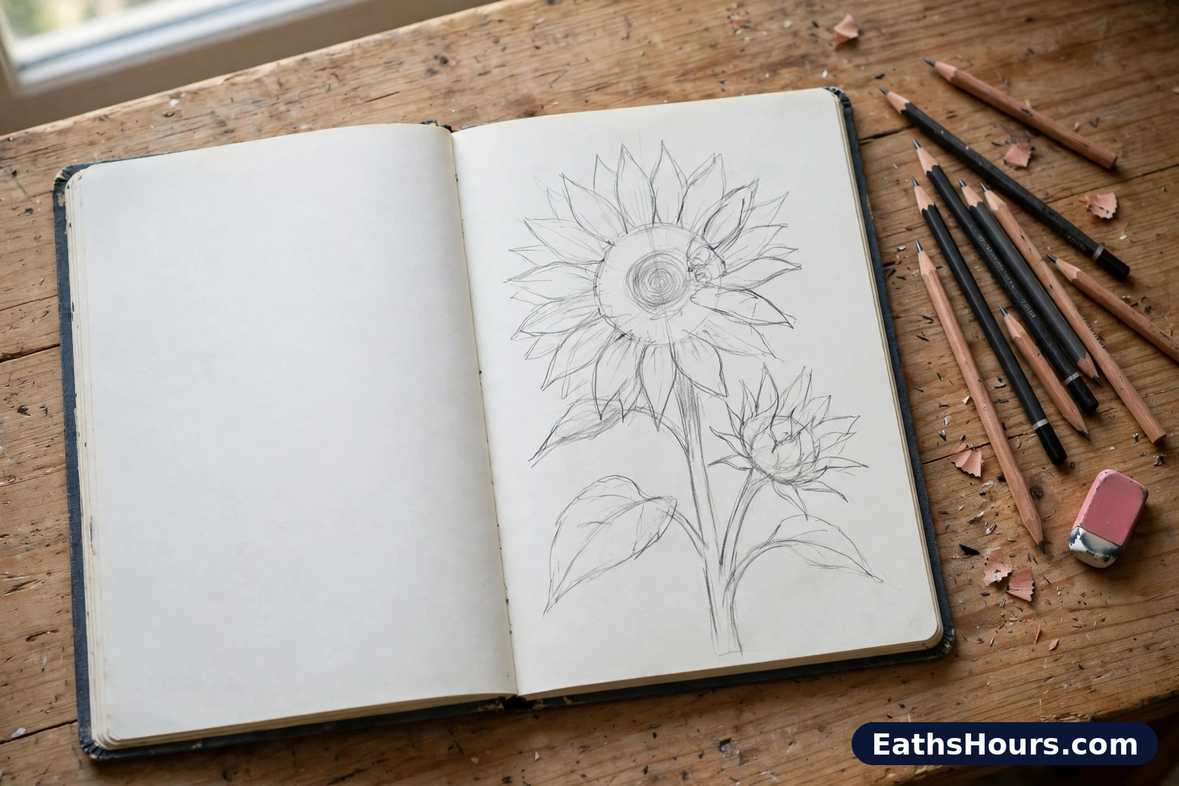
What the Page Asks: A Sheet of Paper, a Pencil, and a Message
The guide’s whole inventory fits in one breath: sixteen short sections, one heading-less opening paragraph, a four-step plan, a five-item tips list, five questions at the end, two hosted photographs, no table, and no conclusion section — its last word before the questions is its creativity section, and the conclusion in this article is this site’s own, placed where the house pattern puts it when a guide has none. Nothing on the page is sold, signed up for or downloaded. The ask is entirely manual: draw this, by hand, and send it.
One detail deserves naming before the sections begin. In the guide’s first section, the phrase “pencil drawing for the Armed Forces of Ukraine” is itself a link, and it leads away from the guide to a news report on rayon.in.ua — a March 2022 item about children in the Rivne region whose drawings in support of the army were published by the head of the regional military administration. That destination is recorded here in plain text and deliberately not linked. It matters for a reason the guide never states: it is the one place the page touches the documented record — and the record, as the practice section below shows, is real, dated and larger than the guide.
The habit used throughout is this site’s usual one, already applied to a bare domain string that resolves nowhere, to a “why is it important” explainer whose subject never existed and to a gadget guide built around a keyboard that was never a product: take each claim back to whatever record it rests on. Here the records are of two kinds — the guide’s own text, followed section by section, and the coverage of the practice itself, quoted with its sources named and its dates attached.
Why It Is Important to Draw a Pencil Drawing for the Armed Forces of Ukraine
The guide opens with value. A pencil drawing for the Armed Forces of Ukraine, it says, has a special emotional worth: simple things made by hand always stir sincere feelings; even the smallest drawing can become a source of inspiration for a warrior defending the homeland; and the pencil, it adds, is a tool within everyone’s reach.
The three parts of that claim are not equally weighted. The accessibility point is the strongest, because it is checkable: the whole equipment list is a sheet of paper and one pencil — no printer, no paints, no cost worth naming — which is why the practice could spread through classrooms within weeks of the full-scale invasion. The handmade point is a claim about how receivers read objects, plausible and widely repeated across the coverage. The inspiration point is the one the record gets to judge, and it is held for the practice section below, where the documented responses are set out with their dates.
What Elements to Add to a Pencil Drawing for the Armed Forces of Ukraine
Plan the symbolism in advance, the guide advises. Its element list is short: the Ukrainian flag; the coat of arms; or a sunflower — in its words, a symbol of unbreakability. Sincere inscriptions, it adds, will make the drawing warmer, and it gives two examples: «Дякую!» (“Thank you!”) and «Повертайтеся живими!» (“Come back alive!”).
The list is worth noticing for what it does not contain. Every element is either a national emblem, a plant, or a sentence addressed to the receiver — nothing decorative for its own sake. The sunflower choice is corroborated from an unexpected direction: when a regional library competition in the Cherkasy region collected more than 450 children’s drawings in the autumn of 2022, the exhibition record describes the recurring motifs as the flag’s blue and yellow, angels over soldiers’ backs, and sunflowers and storks as symbols of national solidarity. The guide’s shelf of elements and the drawings children actually produced are, item for item, the same shelf.
How to Prepare for Creating a Pencil Drawing for the Armed Forces of Ukraine
Preparation matters too, the guide says, and its list is as short as the element list: a clean sheet of paper and a good-quality pencil, got ready first. Then, before any line is drawn, think about which emotions you want to convey — the drawing, it insists, should be not merely pretty but sincere.
Read as craft advice, the order is the content. The materials take a sentence because there is almost nothing to prepare; the deciding takes the emphasis because it is the only real choice the maker has. A drawing whose feeling is chosen in advance — gratitude, encouragement, a wish for a safe return — has its subject chosen with it, and the sections that follow are really elaborations of that one decision.
Step by Step: How to Create a Pencil Drawing for the Armed Forces of Ukraine
To draw a pencil drawing for the Armed Forces of Ukraine easily, the guide says, you can follow a simple plan:
- Draw the outlines of the Ukrainian flag.
- Add a figure of a defender in a bulletproof vest.
- Decorate the composition with symbolic elements, such as sunflowers or doves of peace.
- Write a few warm words on the sheet.
Such simple steps, it concludes, will help even children create a sincere pencil drawing for the Armed Forces of Ukraine.
The sequence is a composition order, and a sensible one: the emblem first, while the sheet is empty and the largest shape can be placed; the figure second, as the human centre; the decoration third, filling the space the first two leave; the words last, in whatever room remains. The defender in the second step is a drawing subject like the flag in the first — a simply drawn standing figure who stands for the person the sheet will reach, not a portrait of anyone. Nothing in the plan requires a drawn detail smaller than a child’s hand can manage, which is the point of it.
Ideas for Inspiration: What to Draw for the Armed Forces of Ukraine in Pencil
Sometimes an idea is hard to invent, the guide concedes, and offers its proven variants: the Ukrainian coat of arms; a guard standing by the flag; or a family waiting for the warrior’s return. A pencil drawing for the Armed Forces of Ukraine, it adds, can also be stylised as a comic or a cartoon, to raise a smile.
The variants divide into emblems and scenes. The emblems repeat the element list in larger form. The scenes are the new material, and the family at home is the strongest of them, because it draws the other end of the drawing’s own journey — the household the receiver is absent from, waiting in the same picture that will travel to him. The comic suggestion is a register choice rather than a subject: the same flag and figure, drawn lighter, on the theory — the guide’s — that a smile is also a form of support.
Why Children Should Draw a Pencil Drawing for the Armed Forces of Ukraine
Children’s drawings, the guide says, have an incredible power: they are a genuine source of emotional support, and when a soldier receives a pencil drawing for the Armed Forces of Ukraine made by a child, he feels real care and hope. Children should therefore be encouraged to create such drawings as often as possible.
Two parts of this can be separated cleanly. That children are the practice’s main makers is documented everywhere the practice is recorded — the collections, competitions and exhibitions below are organised around children’s work almost without exception. That the drawings do what the guide says they do to the men who receive them is a claim about an effect, and effect claims stand on testimony. The strongest dated testimony this article found is set out in the practice section: a named regional official, in March 2022, describing in print what such drawings do at the front. The guide’s sentence stands above as its claim; the testimony below stands as testimony.
How to Pass a Pencil Drawing for the Armed Forces of Ukraine to the Front
Creating the drawing, the guide says, is only the first step. It can be sent through volunteer organisations, by post, or through school campaigns — and that way, each pencil drawing for the Armed Forces of Ukraine will reach exactly where it is most awaited.
The three channels it names are the three the record shows. Volunteer centres are the documented intake point in the earliest coverage: in the Rivne region in March 2022, drawings were to be brought to volunteer centres and sent on to the military together with humanitarian aid. School campaigns are the documented collection form from that spring onward, in school projects and university drives alike. This article adds no addresses of its own — the guide names none, and none are invented here; the working route, then as now, is the local one: the school or volunteer centre that is already collecting.
A Pencil Drawing for the Armed Forces of Ukraine: Emotions That Change the World
Remember, the guide says, that a pencil drawing for the Armed Forces of Ukraine is more than just a picture: it is a message of hope, support and gratitude, and sometimes a simple drawing can give strength and inspiration to a person who is fighting for our life and freedom.
That is the guide’s most expansive framing, and it is carried here as framing. What admits of checking is the traffic, not the transformation: drawings demonstrably get made in large numbers, get collected, get carried with aid, get kept, and get exhibited by serious institutions. Whether they change the world is beyond any record’s reach; that they move along a real circuit, from a child’s desk to a museum wall to a front-line position, is documented at every stop — and the circuit, rather than the slogan, is what the next sections rest on.
Tips for Creating a Better Pencil Drawing for the Armed Forces of Ukraine
The guide’s advice section gives five tips:
- Use clear contours.
- Avoid gloomy dark tones.
- Add positive symbols: the sun, flowers, hearts.
- Write sincere words of gratitude.
- Draw from the soul, even if the drawing turns out imperfect.
Four of the five are about register rather than skill: legible outlines, a bright tonal range, hopeful subjects, words that mean what they say. The fifth is the one the whole guide finally rests on, and it inverts the usual order of a how-to page — the imperfect drawing made sincerely is explicitly preferred to the polished one made carelessly. The second tip deserves a craft footnote, which the technique section below supplies: in graphite, “dark tones” are not a colour choice but a pressure-and-layers choice, and keeping a drawing bright is a matter of how the pencil is handled, not of what is drawn.
How a Pencil Drawing for the Armed Forces of Ukraine Affects the Defenders
According to the feedback of many warriors, the guide reports, drawings support their morale. They remind the defenders that their efforts are not in vain, and through such drawings the warriors feel an invisible but strong connection with the people they are protecting.
The guide’s own attribution — “according to the feedback of many warriors” — goes exactly as far as such an attribution can, and no further: no warrior is named, none is quoted, and no count is offered. That is the normal strength of such claims in this literature, and it is exactly why the documented instances matter. They cannot prove the general claim, but they can show what the claim looks like when it is pinned to a name, a place and a date — which is the work of the section that follows.
The Documented Practice: Drives, Parcels and Exhibitions
The earliest dated record this article found is the very report the guide links to. On 11 March 2022, rayon.in.ua reported that children in the Rivne region were drawing their understanding of the war, and that the head of the regional military administration, Vitaliy Koval, had published their drawings in support of the army. His appeal asked parents to have their children draw what Ukraine, freedom and independence meant to them, and to bring the drawings to volunteer centres, from where they would be sent to the military together with humanitarian aid. Of the drawings themselves he wrote that at the front they are “a charge of energy and faith in the future”, and a motivation to fight on for a peaceful sky over the children who drew them. One named official, one region, one date — testimony, printed at testimony’s strength, and the guide’s effect claim in its most concrete documented form.
The collection form the guide describes is documented at the education system’s other end as well. West Ukrainian National University in Ternopil announced a drive, run by its humanitarian education office, collecting drawings and letters for the Ukrainian military from the children of its employees; the collected items were to be handed to volunteers and sent to the front. School projects, which the guide treats two sections from here, are the same form at a younger age: an institution collects, volunteers carry, the front receives.
The exhibition circuit is documented by a national museum. Kyiv’s War Museum exhibited about 150 drawings by Ukrainian and Polish children from Łódź, collected by the Polish foundation Koper Pomaga, whose action — reported by TVN 24 in May 2022 — had Polish children making drawings and postcards addressed to the soldiers. The museum’s own account adds the detail that completes the circuit: after the exhibition, part of the works would be sent to the Ukrainian defenders on the front line. Display and delivery are not two fates for these sheets; they are two stops on one route.
And the Cherkasy record, already met in the elements section, gives the practice its scale in a single region: a drawing competition run across 40 public libraries in the autumn of 2022 produced more than 450 artworks by children aged six to eighteen, including children displaced from their homes; sixty of the drawings later travelled to the United States for exhibition at a university library. Set beside that record, the guide’s claims about schools, exhibitions and effects are neither inflated nor invented — they are a small page’s summary of a large, documented practice, and they are weighed here at exactly that: the circuit is real, its stops are documented, and any single drawing’s effect on any single receiver remains what the Rivne official’s words are — testimony.
A Pencil Drawing for the Armed Forces of Ukraine in School Projects
Many schools, the guide says, now organise special events where children draw drawings for the warriors. This does more than support the Armed Forces of Ukraine: it teaches children to be grateful, kind and patriotic, and it is a fine opportunity to explain to children the value of peace.
The record supports the organisational half of this directly — the library competition across 40 libraries and the university collection drive above are school-shaped collections, run by institutions, with volunteers as the carrier. The teaching half is the schools’ own framing of their events, reported here as theirs. The record alone supports a narrower sentence, and it is sufficient: the events happen, they are built around children drawing, and the drawings they produce demonstrably leave the building.
Exhibitions of Pencil Drawings for the Armed Forces of Ukraine
Exhibitions showing children’s drawings for the defenders, the guide says, often take place in Ukraine. Such exhibitions have a great influence on public consciousness: they show how important it is to remember those who risk their lives daily for us.
The exhibition claim is the guide’s most easily checked, and it holds beyond its own wording. The Kyiv War Museum — the national museum of the war’s history — exhibited children’s drawings as documents of the period, in a restored seventeenth-century gatehouse; the Cherkasy selection crossed an ocean to a university library in the United States. The “influence on public consciousness” is the guide’s interpretation, carried as its interpretation. The checkable residue is institutional: bodies whose business is public memory chose these sheets as exhibits, a fact both stronger and soberer than the influence claimed for them.
A Pencil Drawing for the Armed Forces of Ukraine as Part of the National Culture
Drawings for the Armed Forces of Ukraine are now becoming, in the guide’s account, part of Ukraine’s contemporary culture. Through such drawings we preserve our memory, our emotions and our pride, and a pencil drawing for the Armed Forces of Ukraine turns into a symbol of the unbreakability of the Ukrainian spirit.
This is the guide’s largest claim, and this article carries it as the guide’s framing, not as a finding of its own — sentiment belongs to the practice’s participants; the record is this page’s business. The record does give the claim one concrete anchor, and it is the museum again: when a national war museum collects children’s drawings into an exhibition about the war’s first hundred days, the drawings have, in that specific institutional sense, entered the culture’s keeping. Beyond that anchor, the sentence stands as the guide wrote it — an interpretation its makers are entitled to, printed with its attribution intact.
A Pencil Drawing for the Armed Forces of Ukraine: What Else Can Be Added
Besides the traditional symbols, the guide continues, you can draw all kinds of landscapes — a field, a river, a flowering garden. Such pictures remind the warriors of what they are fighting for. It is also important, it says, to draw smiling people, happy children and a peaceful sky.
The additions are an inventory of the home front: field, river, garden, faces, sky. One of them closes a loop with the documented record — the “peaceful sky” the guide lists as a subject is the same image the Rivne official’s March 2022 appeal reached for, when he described the drawings as motivation to fight for a peaceful sky over the children who drew them. Guide and record were written independently, three years apart; that they name the same picture is the kind of small corroboration a check like this one exists to notice.
How to Teach a Child to Draw a Pencil Drawing for the Armed Forces of Ukraine
The best way, the guide says, is to begin with simple forms — draw a flag, or a little heart. Then invent a plot together. And it is very important, while drawing, to tell the child why they are doing it: then a pencil drawing for the Armed Forces of Ukraine will be not just creativity, but a sincere expression of care.
As teaching sequence this is sound, and it matches the guide’s own step plan at a smaller scale: the simplest closed shapes first, composition second, meaning throughout. The talking, though, is where this section’s substance sits. The explanation is not decoration added to the activity; on the guide’s account it is what converts a drawing exercise into the thing the whole page is about — a message whose sender understands that it is one.
Working in Pencil: Light Lines First, Tone Last
Underneath the guide’s advice sits a small body of craft, stated here at the strength on which drawing instruction generally agrees. The pencil’s core is graphite, a soft form of carbon — the name comes from the Greek graphein, to write or draw — and pencils are graded by hardness: H grades are harder and mark lighter, B grades are softer and mark darker, HB sits between. Almost everything the guide asks for is done with the middle of that range and a light hand.
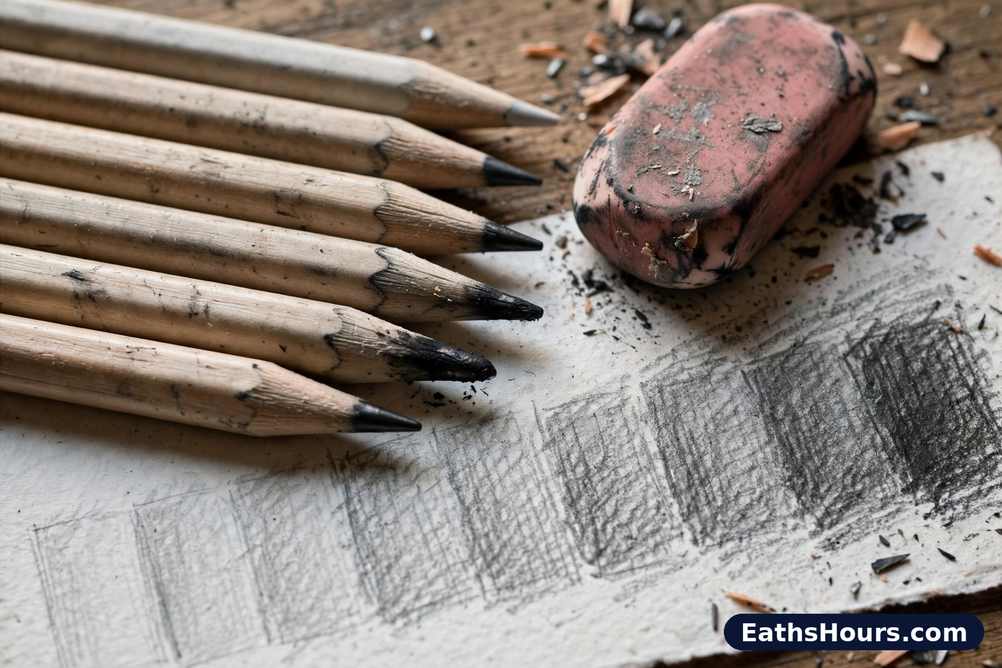
Construction comes first. Begin with a light sketch — pale lines that place the main shapes and can still be erased — and only then commit to the final contours. The guide’s own order is a construction order without naming itself one: the flag’s outline placed first on the empty sheet, the figure set against it, the decoration fitted into the remaining space, the words last of all. Drawn lightly at first, every one of those stages can still be moved; drawn heavily at once, none can.
Tone is built, not pressed. Dark areas are made by repeated light passes — layers — rather than by bearing down once, which flattens the paper’s surface and makes the mark shine; parallel lines laid closer together read darker and further apart read lighter, which is hatching, and a second set of lines across the first deepens the tone again. The eraser belongs to the same kit as a drawing tool, not only a repair: lifted graphite reopens a highlight, a shirt, a patch of sky. The guide’s second tip — avoid gloomy dark tones — is, in these terms, an instruction about rationing: keep the drawing’s values in the light-to-middle register, spend the deep layers nowhere, and leave plenty of white paper showing. The brightness it wants is a handling, not a subject.
The habit underneath all of this — work from the thing itself, lightly at first, and let every later mark answer to what is already on the sheet — is the same discipline this site brought to subjects as unlikely as a classroom tool label: attend to the object in front of you, and make descriptions of it earn their keep.
Supporting the Armed Forces of Ukraine Through Creativity: A Pencil Drawing
Creativity, the guide closes, has always been a source of inspiration, and through drawings we can support the Armed Forces of Ukraine even without great effort. Everyone who has drawn a pencil drawing for the Armed Forces of Ukraine even once becomes part of a large community of grateful Ukrainians.
This is the guide’s last word before its questions — its page has no separate conclusion — and its community claim can be weighed against the record assembled above. A community is exactly what the documented circuit makes visible: Rivne parents answering an official’s appeal, Łódź schoolchildren drawing postcards for soldiers in another country, forty libraries running one competition, a national museum hanging the results. The guide’s sentence is warmer than the record’s, as closing sentences are; the record does not contradict it.
Conclusion
The guide is a small craft syllabus — an element list, a preparation, four steps, five tips — wrapped around a documented practice. Followed on its own terms, it produces what it promises: a sincere sheet, drawn by hand, with an emblem, a figure, a few hopeful symbols and a short inscription. Set against the record, its larger claims sort themselves honestly. The collections, the volunteer carriage, the school projects and the exhibitions are documented, with names and dates. The effect on the defenders is testimony — one named official’s words from March 2022 being its most concrete form. The culture claim is an interpretation, anchored at exactly one institutional point. Nothing in the sorting diminishes the drawing; it only keeps each kind of claim at the strength its evidence carries.
What the drawing is made of deserves the last word, because it explains the genre’s whole reach. Paper costs almost nothing, and the pencil’s core is graphite — a soft carbon that has marked paper for centuries precisely because it asks so little of the hand holding it: no ink to spill, no paint to mix, nothing to charge. A medium that cheap and that forgiving is how the smallest participant in a country’s hardest years — a child at a school desk, with a flag to outline and a sunflower to shade — can send something real along the documented route: not a supply, but a message, drawn from the soul in the guide’s own closing phrase, and worth what the receivers in the record say it is worth.
Frequently Asked Questions About a Pencil Drawing for the Armed Forces of Ukraine
What is a pencil drawing for the Armed Forces of Ukraine?
A picture drawn by hand, in pencil, and addressed to Ukraine’s defenders — most often made by a child, carrying national symbols and a few words of thanks, and sent on through a school or volunteer collection.
What symbols should be used in a pencil drawing for the Armed Forces of Ukraine?
The guide’s set: the Ukrainian flag, the coat of arms, sunflowers, hearts and doves of peace — the same motifs the exhibition record shows children actually drawing, from Rivne in 2022 to the Cherkasy competition.
Do words need to be written on a pencil drawing for the Armed Forces of Ukraine?
The guide says yes, and the practice agrees: the inscription is the part that addresses the receiver directly. Its own examples are «Дякую!» (“Thank you!”) and «Повертайтеся живими!» (“Come back alive!”) — keep it that short, and that sincere.
Where can a pencil drawing for the Armed Forces of Ukraine be handed over?
Through the channels both the guide and the record name: a school collection, a volunteer organisation or volunteer centre, or a postal campaign — the routes by which drawings have travelled with humanitarian aid since March 2022.
Why is it important to draw a pencil drawing for the Armed Forces of Ukraine?
Because it is the support a child can actually make — cheap, handmade and personal — and because, on the testimony in the record, it is received at the front as energy, and as a picture of the peaceful sky it names.