One Tap, No ID? What Research Shows About Online Alcohol Delivery
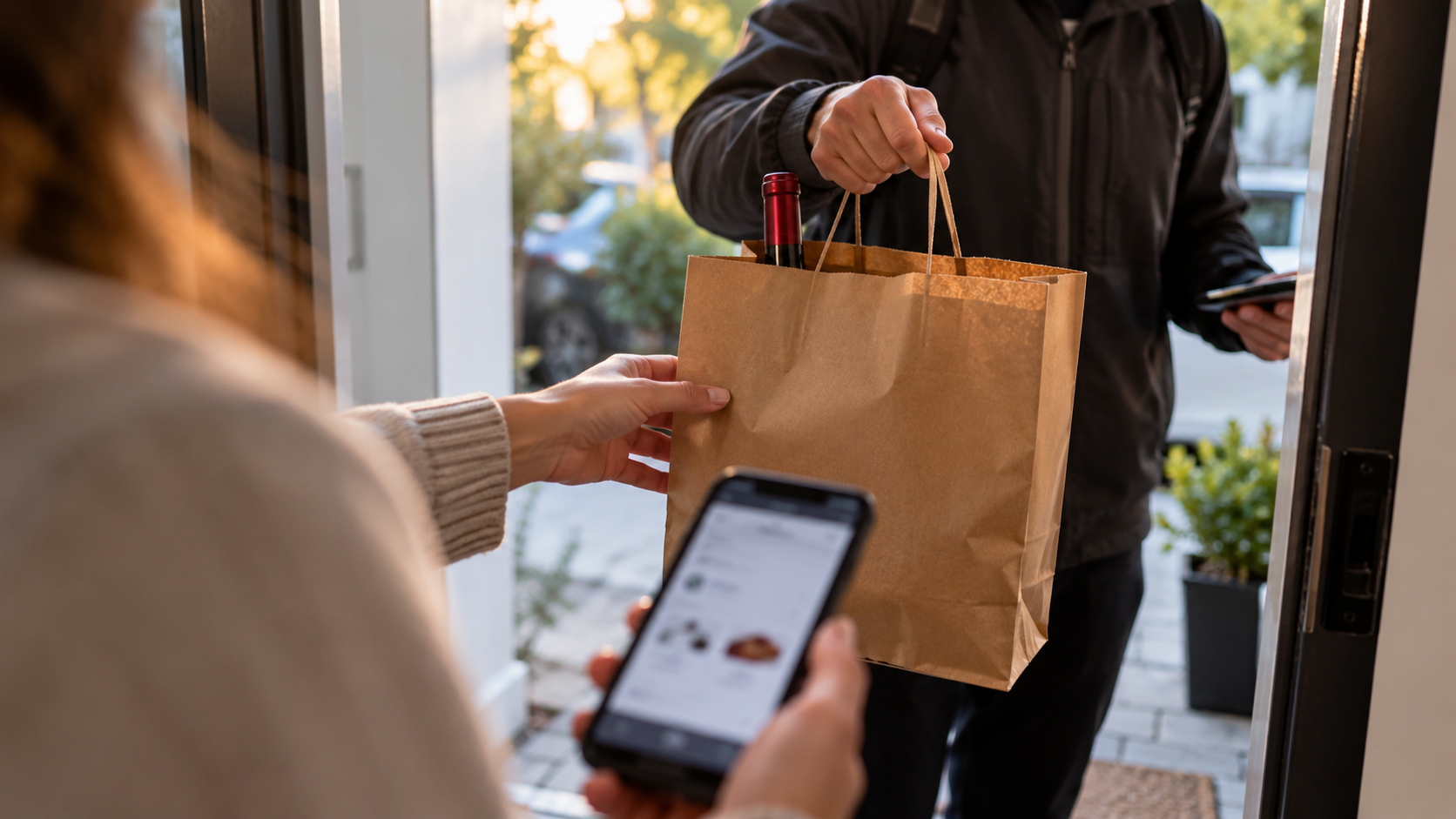
Ordering a bottle of wine now takes about as much effort as ordering a pizza. You open an app, tap a box confirming your age, pay, and a driver arrives a little later. That convenience is the whole selling point, and it is also what public health researchers are starting to question.
In May 2025, RNZ reported that public health experts in New Zealand were warning that online alcohol delivery was fueling alcohol-related harm. Steve Randerson, co-chair of the expert panel of Health Coalition Aotearoa, told RNZ that “every phone is now a really sophisticated advertising platform and a bottle store.” The same report pointed to research in the New Zealand Medical Journal which found that about three-quarters of alcohol deliveries to Auckland homes were handed over without an ID check or left on the doorstep.
The debate is usually framed around minors, but the research also looks at adults who drink heavily. For people trying to cut back, convenience can work against them, and when drinking has become hard to control, help ranges from a conversation with a primary care doctor to structured settings like luxury inpatient rehab services in Malibu, where treatment takes place away from home. Before getting to that, it helps to understand how the technology is supposed to work and where it falls short.
How Age Checks Are Supposed to Work
Online alcohol delivery typically relies on two checkpoints. The first is at checkout, where the buyer confirms they are of legal drinking age. RNZ noted that under New Zealand’s law, remote sellers are expected to take “reasonable steps” to verify age, which can be as simple as an onscreen box confirming the buyer is 18. Proof of age is not legally required at purchase or delivery there.
The second checkpoint is at the door, where the driver is meant to look at photo ID before handing over the order. In the Auckland study discussed below, all 16 companies tested had a written policy requiring ID to be checked on delivery. In theory, the door check is the real safeguard. In practice, the studies below suggest it is the step most likely to be skipped.
What Test Purchases Have Found
New Zealand
The Auckland study, published in the New Zealand Medical Journal on November 29, 2024 by Sarah Sneyd of Alcohol Healthwatch and Molly Richardson of the University of Auckland, used a research assistant aged over 18 but under 22 to place 46 orders with 16 online alcohol delivery companies in 2023. Of the 45 orders delivered, 73% involved no ID check. Nearly half (49%) were left unattended at the door, and 24% were handed over in person without anyone asking for ID. Ten of the 16 companies never checked ID, even though all 16 had a policy requiring it on delivery.
United Kingdom
Alcohol Change UK published similar findings in March 2022. In test purchases where 18- and 19-year-olds ordered alcohol for delivery within two hours, alcohol was handed over without proof of age in 72% of cases, which the charity said broke the retailers’ own policies. A separate review of online age verification, commissioned from Wrexham Glyndŵr University, described current website methods as “largely ineffectual.”
California
In 2020, California’s Department of Alcoholic Beverage Control ordered about 200 drinks through delivery services using decoys under 21. According to coverage in The Takeout, which cited interviews with the department’s director in the Washington Post, about 80% of drinks ordered through third-party apps reached the decoys without an ID check, compared with a 25% failure rate for restaurants and bars. A follow-up sting after regulators contacted the services still found about 50% getting through.
Where the Gaps Open Up
None of these studies suggest the technology is impossible to fix. They point to specific weak spots in how age checks are designed and carried out. Across the research, a few recurring problems stand out.
- Checkbox age gates: In the Auckland study, only 15% of the 46 orders triggered any online age confirmation at checkout, and a tick box relies entirely on the buyer telling the truth.
- Contactless drop-offs: The same study found that nearly half of deliveries were simply left at the door, which removes the face-to-face moment where ID could be checked.
- Driver training: Qualitative research for Alcohol Change UK found drivers were confused about retailers’ age verification policies and had not received effective training on them.
- Speed: Rapid deliveries in Auckland took an average of about 30 minutes, leaving little time between a decision to drink more and having the alcohol in hand.
- Intoxicated customers: A 2023 report by Australia’s Foundation for Alcohol Research and Education (FARE) cited survey data in which 61% of weekly delivery recipients in a 2020 VicHealth survey said they were intoxicated when they received alcohol.
Taken together, these gaps show that a policy written into an app’s terms is not the same as a check that happens at the door. The Auckland researchers concluded that additional regulation is needed, and the authors of an Australian study discussed below recommended that delivery rules match the standards for bricks-and-mortar bottle shops.
These concerns extend beyond alcohol. Other age-restricted products, including nicotine products, also raise questions about consumer awareness and access. For example, our overview of ZYN nicotine pouch flavors discusses nicotine addiction risks and why people who do not already use nicotine should avoid starting.
It Is Not Only About Teenagers
The research also looks at how delivery fits into adult drinking patterns. A 2023 study in Drug and Alcohol Review by Stephanie Colbert and colleagues surveyed 1,158 Australian adults who had recently used alcohol delivery. About one in five (20.1%) had used delivery to keep drinking at home after running out, and about a third of that group said they would have stopped if delivery had not been available. Using delivery this way was associated with higher odds of hazardous or harmful drinking, although the design cannot show cause and effect.
A study of 465 Western Australian delivery users, led by Kerri Coomber and published in Drug and Alcohol Review in 2024, found that people classed as high-risk drinkers were more likely to use same-day delivery, to order alcohol to continue a drinking session, and to receive deliveries while intoxicated. They also ordered larger quantities, an average of 49 standard drinks compared with 32 for lower-risk drinkers. The authors suggested measures such as a mandatory delay between ordering and delivery.
If Delivery Makes Cutting Back Harder
For anyone who notices that delivery apps are part of a pattern they want to change, the practical advice is fairly simple. Harvard Health Publishing, drawing on guidance from the National Institute on Alcohol Abuse and Alcoholism, suggests keeping a diary of every drink for a few weeks, setting a clear drinking goal, choosing alcohol-free days, and not keeping alcohol in the house. In a world of 30-minute delivery, that last tip may also mean deleting the apps or turning off their notifications.
The same guidance recommends asking friends, family, a doctor, or a counselor for support, and notes that people who depend on alcohol, or who have other medical or mental health problems, should stop drinking completely. If repeated attempts to cut back are not working, that is a sign to talk with a health professional rather than relying on willpower alone.
Frequently Asked Questions (FAQs)
1. Do online alcohol delivery services check ID at the door?
Many have policies saying they do, but test purchases show the checks are often skipped. In Auckland, 73% of deliveries involved no ID check, and in UK test purchases, 72% of rapid deliveries to 18- and 19-year-olds were handed over without proof of age.
2. Is ticking an age box at checkout a real form of age verification?
It depends entirely on the buyer being honest. A review commissioned by Alcohol Change UK described current online age verification methods as “largely ineffectual,” which is why researchers focus on the check at the door.
3. Can alcohol delivery affect how much adults drink?
Australian research links certain uses of delivery with heavier drinking. In the 2023 Colbert study, about a third of people who ordered more alcohol after running out said they would otherwise have stopped, though the findings show an association rather than proof that delivery causes heavier drinking.