Crew Disquantified Org Explained: Meaning, Updates & Details 2026
The phrase crew disquantified org can be confusing because it looks like the name of an organization, website, or formal system. It also contains the unusual word “disquantified,” which is easy to confuse with disqualified. Current online references use the phrase in more than one way, so context matters when trying to understand it.
Some references connect the term with crewdisquantified.org, while others use it to discuss teamwork, organizational structures, data, and the limits of numerical performance measurement. The public information available about the associated website is relatively limited, so it is important not to present assumptions as established facts.
This guide explains the meaning of Crew Disquantified Org, the difference between disquantified and disqualified, how crew qualification systems work in real industries, why teams can face disqualification, and how technology is changing organizational management.
What Does Crew Disquantified Org Mean?
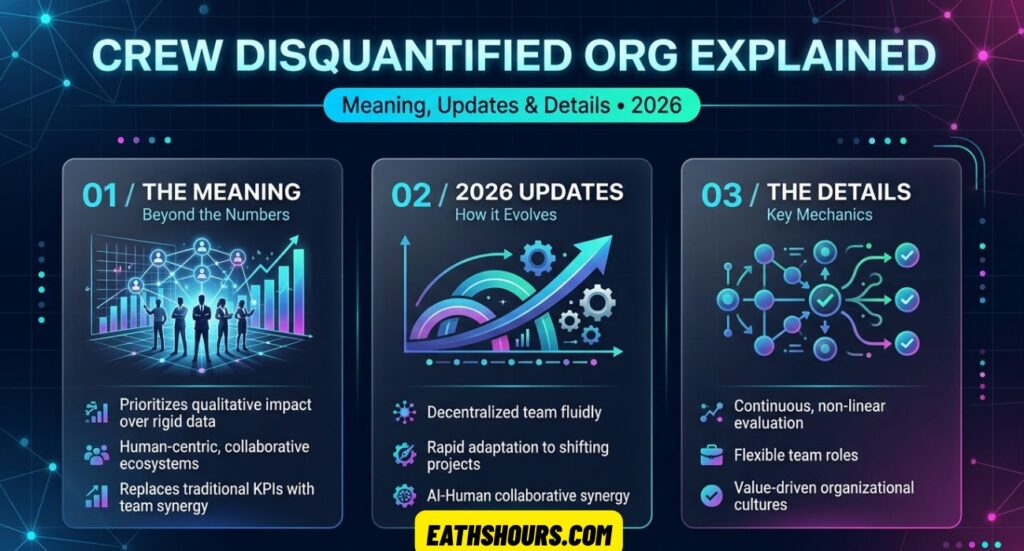
Crew Disquantified Org does not currently have one universally accepted definition. The phrase appears to be used both as an online identity associated with Crew Disquantified and as a broader expression connected with organizations, teams, data, and measurement.
The easiest way to understand the phrase is to separate its three parts:
| Term | General meaning |
|---|---|
| Crew | A group of people working together toward a shared task or objective |
| Disquantified | An uncommon term that can suggest moving away from excessive dependence on numerical measurements |
| Org | A common abbreviation for organization |
The word disquantified is particularly important. It should not automatically be read as “disqualified.” Disqualification normally means that a person, team, entry, or organization has failed to meet a rule or requirement and is therefore removed from eligibility.
By contrast, the online interpretation of disquantified is more closely associated with questioning whether people or teams should be judged mainly through scores, rankings, KPIs, or other numerical measures. Some recent coverage describes it as a critique of organizations that allow metrics to replace context and human judgment.
There is another side to the term. The actual Crew Disquantified website describes the name as something that has circulated in finance and internet communities, while acknowledging that its identity and purpose can be unclear.
For that reason, the safest interpretation is to separate the website identity from the broader organizational concept.
Crew Disquantified Org vs. Crew Disqualification
These terms sound similar but describe different ideas.
Crew disqualification is a real concept in many industries. A crew can be disqualified when it violates a competition rule, safety requirement, licensing condition, technical standard, or eligibility requirement.
Disquantification, on the other hand, is not a standardized industry-wide term comparable to disqualification. In current online discussions, it is generally used as an interpretive idea about reducing excessive reliance on numerical evaluation.
| Concept | Meaning | Typical context |
|---|---|---|
| Crew qualification | Meeting required standards | Aviation, maritime, sports, technical work |
| Crew disqualification | Losing eligibility after failing a rule or requirement | Competitions, regulated operations |
| Quantification | Turning information or performance into measurable values | Business, analytics, management |
| Disquantification | A proposed idea of moving beyond overly narrow numerical evaluation | Organizational and online discussions |
This distinction prevents one of the biggest misunderstandings around the keyword.
Understanding Crew Disqualification in Real Industries
Although the phrase crew disquantified org is ambiguous, crew disqualification itself is easy to understand in established industries.
A crew normally has to meet a set of requirements before it can perform a regulated, competitive, or safety-sensitive activity. These requirements can include training, certification, equipment standards, conduct rules, registration, or operational procedures.
For example, a competition crew may be disqualified for breaking event rules. A maritime crew may face restrictions if required certifications are missing. In safety-sensitive industries, personnel may also lose authorization when mandatory training or qualification requirements are not maintained.
The exact rules depend entirely on the industry and governing body.
Why Qualification Matters
Qualification systems exist because some activities require a minimum level of competence and reliability.
A qualification framework can help establish:
- Required skills
- Training standards
- Safety procedures
- Equipment knowledge
- Professional responsibilities
- Eligibility requirements
- Accountability
This means disqualification is not necessarily a punishment for poor performance. In many situations, it is simply the result of failing a defined eligibility condition.
Possible Origin of the Term Crew Disquantified Org
There is no strong evidence establishing one definitive origin story for the phrase.
Current online coverage indicates that the term became more visible during 2025–2026, with different websites interpreting it as a domain identity, organizational concept, or discussion about the relationship between people and numerical performance measures.
The actual Crew Disquantified website uses the name “Crew Disquantified Org” and has sections covering areas such as finance, crypto, technology, business, money saving, and general content. Its About Us page does not provide enough detailed organizational information to establish it as a widely recognized institution.
That limited public footprint explains why searchers may find conflicting descriptions.
Some pages treat the phrase as a website or digital identity. Others use it as a concept about organizational measurement. These should not automatically be treated as the same thing.
Why the Name Creates Confusion
The wording itself is unusual.
“Crew” sounds like a team.
“Org” sounds like an organization.
“Disquantified” sounds technical but does not have a universally established meaning in organizational management.
As a result, readers may naturally assume that the phrase refers to a formal company, nonprofit, research group, or management framework when the available evidence does not establish that conclusion.
Crew Qualification and Disqualification Systems Explained
A typical qualification system works through a series of requirements.
1. Eligibility
The crew must first meet basic eligibility conditions. These can involve age, registration, licensing, membership, equipment, location, or other requirements.
2. Training and Certification
Some industries require formal training or certification before a person can perform certain duties.
3. Performance or Compliance Checks
The organization or governing body may check whether participants follow required procedures.
4. Review
If a potential violation occurs, an authorized reviewer may examine the circumstances.
5. Decision
The final decision may range from no action to a warning, correction, suspension, or disqualification, depending on the applicable rules.
A good qualification system should make these requirements clear before participation begins.
See Also : How Long Until 2:30 PM? See Live Now
How Disqualification Affects Teams and Organizations
Disqualification can have consequences beyond the individual person involved.
A crew may lose:
- Competition eligibility
- Access to an event
- Professional authorization
- Reputation
- Revenue opportunities
- Ranking or points
- Client confidence
The severity depends on the rules and circumstances.
A minor administrative issue may be correctable. A serious safety violation can have much more significant consequences.
Organizations therefore benefit from having clear policies, documented procedures, training, and appeal mechanisms.
The Difference Between Failure and Disqualification
Not every mistake should result in disqualification.
A team can perform poorly without violating a rule. Poor performance and rule-breaking are separate issues.
For example, a crew that finishes last in a competition may still remain fully qualified. A crew that violates a mandatory competition rule could potentially be disqualified even if it performs extremely well.
That distinction is important because qualification concerns eligibility and compliance, while performance usually concerns results.
Rules and Compliance in Crew-Based Systems
Rules provide the framework that determines whether a crew can participate or continue operating.
Strong compliance systems normally make requirements understandable before problems occur.
Clear Rules
Participants should know what is allowed and what is prohibited.
Consistent Enforcement
Similar violations should generally receive similar treatment. Inconsistent enforcement can damage trust.
Documentation
Organizations should maintain records of training, certifications, incidents, decisions, and corrective actions where appropriate.
Review and Appeals
A fair system may provide a method for challenging an incorrect or disputed decision.
Regular Updates
Rules can change as technology, safety requirements, laws, and industry practices develop.
These principles apply to sports teams, transportation crews, technical teams, workplaces, and other organized groups, although the actual standards vary by sector.
Why Metrics Can Become a Problem for Organizations
The broader disquantified interpretation becomes more interesting when organizations rely heavily on performance metrics.
Numbers are useful. A company can measure sales, response time, customer satisfaction, production volume, error rates, and many other indicators.
The problem starts when a measurement becomes a substitute for judgment.
Imagine a customer support team that is rewarded mainly for closing tickets quickly. Employees may learn to close tickets faster even when customers still need help.
The metric improves, but the underlying customer experience may become worse.
This is one reason recent discussions around the term describe “disquantification” as a situation where measurable activity becomes more important than the complete value of the work.
What Does a Balanced Crew Management System Look Like?
A better system does not need to eliminate numbers.
Instead, it can combine quantitative data with qualitative evaluation.
| Work area | Useful metric | Additional context |
|---|---|---|
| Customer support | Resolution time | Customer feedback and quality reviews |
| Operations | Production volume | Error rates and safety observations |
| Engineering | Development cycle time | Code quality and incident reviews |
| Sales | Revenue | Customer retention and relationship quality |
| Content | Traffic | Accuracy, usefulness, and audience response |
This approach reduces the risk of making one number responsible for an overly complicated decision.
The idea is simple: metrics should inform judgment, not replace it.
Impact of Technology on Crew Management Systems
Technology has made crew management much more measurable.
Modern organizations can track work through dashboards, scheduling systems, digital forms, productivity software, automated scoring, analytics platforms, and artificial intelligence.
These tools can provide real benefits.
They can help managers:
- Identify delays
- Monitor workloads
- Detect patterns
- Organize schedules
- Track compliance
- Find operational problems
- Compare results over time
However, automated measurement also creates risks when users cannot understand how a score was calculated.
Algorithmic management can become particularly sensitive when an automated score affects someone’s pay, schedule, access to work, or professional standing.
For that reason, organizations should consider transparency, human review, data accuracy, privacy, and appeal processes when technology is used for high-impact decisions.
How to Evaluate Crew Disquantified Org Safely
If you encountered crew disquantified org while searching online, do not assume that the phrase alone proves what the organization does.
Start by checking the exact domain and its primary pages.
Look for:
- A clear About page explaining who operates the site.
- Reliable contact information rather than only an anonymous form.
- Author information for published content.
- Privacy and terms pages explaining how the site operates.
- Independent references that provide specific evidence.
- Consistent descriptions across the site’s pages.
- Clear disclosures if money, financial products, or personal information are involved.
The current About Us page for Crew Disquantified identifies the site and provides categories including finance, crypto, technology, business, and money-saving content, but it gives limited information about its organizational structure.
That does not by itself prove that the site is unsafe or fraudulent. It simply means readers should use normal due diligence before treating it as an authoritative organization.
Be Careful With Similar Domains
One useful precaution is checking the exact spelling.
crewdisquantified.org, disquantified.org, and other similarly named domains should not automatically be assumed to belong to the same operator.
A similar domain name is not proof of a shared organization.
See Also : Who Is Constantine Yankoglu? The Untold Story of Patricia Heaton’s
Future of Crew Qualification and Organizational Standards
The future of crew management is likely to involve a combination of data, automation, human judgment, and stronger transparency.
Organizations will continue to use technology because measurement provides useful information. At the same time, more attention is being given to problems that occur when automated systems become too rigid.
A balanced future model may include:
- Fewer but more meaningful KPIs
- Human review for important decisions
- Transparent scoring systems
- Clear appeal procedures
- Better data governance
- Privacy protections
- Regular audits
- Qualitative feedback
- Skills-based development
This approach can make organizations more accountable without reducing every person or team to a single number.
What Readers Should Take Away From Crew Disquantified Org
The most important point is that Crew Disquantified Org is an ambiguous term.
It can refer to the online identity associated with Crew Disquantified, while other recent articles use the phrase to discuss organizations that question excessive reliance on metrics. The website’s own About page provides limited organizational detail, so stronger claims should be treated cautiously.
It is also important to keep disquantified and disqualified separate.
Disqualification is an established concept involving failure to meet a rule or eligibility requirement. Disquantification, in the current online usage surrounding this keyword, is better understood as an emerging or interpretive term related to measurement and human contribution rather than as a formal qualification status.
FAQs About Crew Disquantified Org
What is Crew Disquantified Org?
Crew Disquantified Org is an ambiguous online term associated with Crew Disquantified and with broader discussions about teams, organizational structures, data, and numerical performance measurement. Its meaning depends on context.
Is Crew Disquantified Org a real organization?
There is a website using the Crew Disquantified name, but the available public information is not sufficient to confidently classify it as a widely recognized company, nonprofit, or formal research organization.
What does “disquantified” mean?
In current online discussions, disquantified generally suggests reducing excessive dependence on numerical measurements and giving greater consideration to context, judgment, collaboration, and qualitative contribution. It is not the same as “disqualified.”
Is disquantified the same as disqualified?
No. Disqualified normally means that someone or something has lost eligibility because of a rule violation or failure to meet a requirement. Disquantified is an uncommon term associated with criticism of excessive quantification.
What causes crew disqualification?
The reason depends on the industry. Common possibilities can include rule violations, missing qualifications, safety breaches, improper equipment, registration problems, or failure to meet competition requirements.
Why are organizations concerned about too many metrics?
Too many metrics can cause teams to focus on what is easiest to measure instead of what creates the most value. A balanced approach uses numerical indicators together with human judgment and qualitative information.
Is crewdisquantified.org the same as disquantified.org?
They should not automatically be treated as the same website or organization. Similar domain names do not establish common ownership. Users should check the exact domain and primary-source information before making that connection.
Should I provide personal or financial information to a site using this name?
Use normal online due diligence first. Check the site’s ownership information, privacy policy, terms, contact details, reputation, and the specific reason the information is requested. For financial activity, use additional verification before sending money or sensitive information.
Conclusion
Crew Disquantified Org is an unusual search term with more than one interpretation. Current online material connects it with the Crew Disquantified website as well as with broader discussions about teamwork, organizational systems, data, and the limits of numerical evaluation. The public information available about the associated organization is limited, so readers should separate confirmed information from interpretation.
The biggest terminology point is simple: disquantified does not mean disqualified. Crew disqualification is a formal concept in many real industries where teams can lose eligibility for failing rules or requirements. Disquantification, by comparison, is an uncommon term used online to question whether numbers and performance metrics should dominate how people and teams are evaluated.
If you are researching Crew Disquantified Org, focus on the exact website, verify important claims, and avoid assuming that every third-party article describes the same entity. That approach gives you a clearer and more reliable understanding of the term.