OrcaCyber Qwen3.8 Flash Next: 91.9 on Coding, 58.7 on Repair
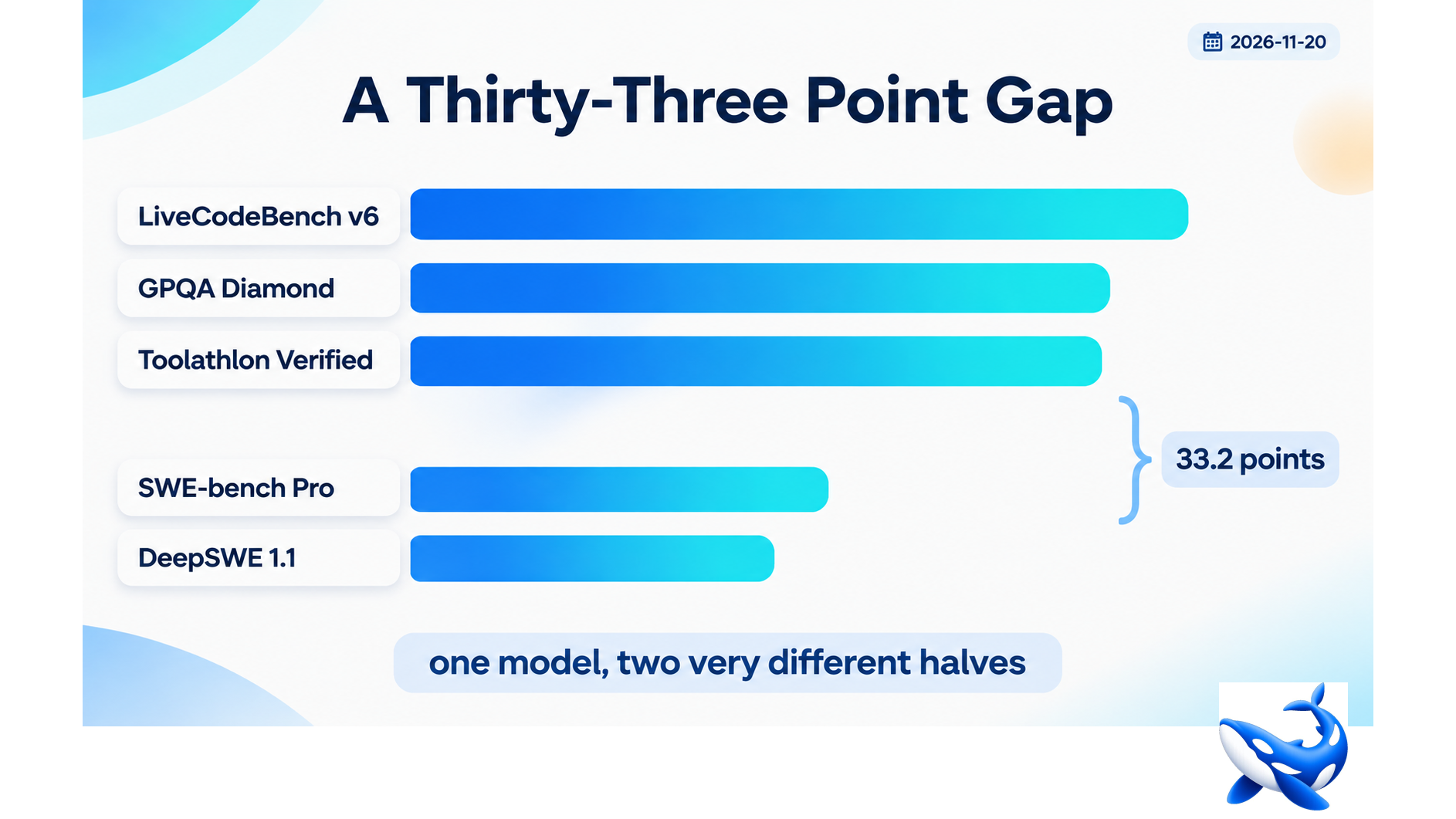
Ninety-one point nine on LiveCodeBench and 58.7 on DeepSWE are the same model’s scores, and the 33.2-point gap between them is the widest split at the band. OrcaRouter publishes all five rows as evaluated scores. They sit on OrcaCyber Qwen3.8 Flash Next benchmarks.
The block
| benchmark | score |
| LiveCodeBench v6 | 91.9 |
| GPQA Diamond | 91.7 |
| Toolathlon Verified | 73.5 |
| SWE-bench Pro | 62.5 |
| DeepSWE 1.1 | 58.7 |
Three rows cluster between 73.5 and 91.9 and two sit between 58.7 and 62.5. The 33.2-point spread from top to bottom is the widest among the cards that publish benchmark blocks.
The split follows a line. The high three are competitive programming, graduate science and tool-use workflows — tasks with a defined endpoint and a short horizon. The low two are repository-level repair and software-engineering agent work — tasks that need many dependent edits across files.
That is a coherent profile rather than noise. A model strong on isolated problems and weaker on multi-file work is a specific tool, and the benchmark block names both halves of it.
Where the split sits in the tier
| card | rows | highest | lowest | spread |
| Flash 1.0 | 6 | 90.9 | 15.3 | 75.6 |
| Hy4 Flash | 6 | 83.6 | 14.1 | 69.5 |
| MiMo V2.6 Flash | 4 | 95.1 | 47.5 | 47.6 |
| Qwen3.8 Flash Next | 5 | 91.9 | 58.7 | 33.2 |
| GLM 5.3 Flash | 5 | 92.0 | 67.9 | 24.1 |
| Zero 1.5 | 4 | 100 | 76.5 | 23.5 |
| MiniMax M3.1 Flash | 4 | 88.6 | 68.0 | 20.6 |
Two cards have wider spreads, and both of them include an ExploitGym row in the low teens. Remove that single test and their profiles tighten sharply.
This card’s spread comes from two *related* tests both landing in the high fifties and low sixties. SWE-bench Pro and DeepSWE 1.1 are both repository-scale software work, and a model that scores 62.5 and 58.7 on them is consistently weak on that class rather than unlucky on one test.
That consistency is the finding. A single low row is a data point; two low rows on the same class of task is a description.
The comparable rows
Cross-card comparison is only sound where the test and variant match. Two rows here are shared.
| test | Qwen3.8 Flash Next | others |
| GPQA Diamond | 91.7 | GLM 5.3 Flash 91.2 · Flash 1.0 90.9 · MiniMax M3.1 Flash 88.6 · Hy4 Flash 83.6 |
| SWE-bench Pro | 62.5 | Zero 1.5 76.5 (Pro V2) |
On GPQA this card leads the five published rows by 0.5 points — a dead heat with GLM 5.3 Flash and a clear lead over the other three.
On SWE-bench the variants differ: this card’s is SWE-bench Pro, Zero 1.5’s is SWE-bench Pro V2. Those are different tests and the comparison is not sound, so the card’s 62.5 has no published peer.
The LiveCodeBench row is v6 here and the base version on GLM 5.3 Flash’s 80.5, so that comparison is unsound too. This card’s 91.9 against 80.5 would look like an 11-point lead and may not be one.
Two of five rows being comparable is the normal state of a cross-card benchmark table on this tier. It is worth saying out loud before anyone quotes a ranking.
What the profile is good for
| job shape | relevant rows | verdict |
| isolated coding problems | LiveCodeBench 91.9 | strong |
| graduate-level technical questions | GPQA 91.7 | strong |
| tool-using workflows | Toolathlon 73.5 | moderate |
| multi-file repository repair | SWE-bench Pro 62.5 · DeepSWE 58.7 | weak |
| security-domain triage | none published | unknown |
The last row is the gap that matters most on this tier. Five cards publish a security-domain score; this one does not, so a buyer cannot place it against Flash 1.0’s CyberGym 88.1 or MiMo V2.6 Flash’s 95.1.
That absence is a fact about the card, not about the model. A vendor chooses what to publish, and this block names three general coding rows, one science row and one tool-use row.
A buyer whose work is repository-scale should weight the bottom two rows heavily and look elsewhere. A buyer whose work is single-problem analysis or tool orchestration has a strong published case for this card at a band price — and should note that its 1.60% error rate is the highest on that band.
Two repositories-scale scores and what they agree on
SWE-bench Pro at 62.5 and DeepSWE 1.1 at 58.7 are 3.8 points apart, which is close enough to be a description rather than two samples.
| card | repository-scale row | score |
| Flash 1.0 | DeepSWE v1.1 | 74.2 |
| Hy4 Flash | DeepSWE v1.1 | 68.3 |
| MiMo V2.6 Flash | DeepSWE v1.1 | 67.9 |
| Qwen3.8 Flash Next | DeepSWE 1.1 | 58.7 |
| Zero 1.5 | SWE-bench Pro V2 | 76.5 |
| Flash 1.0 | SEC-Bench Pro | 62.8 |
| Qwen3.8 Flash Next | SWE-bench Pro | 62.5 |
| Hy4 Flash | SEC-Bench Pro | 57.8 |
| MiMo V2.6 Flash | SEC-Bench Pro | 47.5 |
On the DeepSWE row this card is last of four, 15.5 points behind Flash 1.0. On SWE-bench Pro it is last of two, and the two tests agree about its standing.
That agreement is what makes the weakness a finding. A single low score invites the argument that the test was unfair or the variant unusual; two rows on the same task class landing within four points of each other does not.
The other half of the block is equally consistent. LiveCodeBench v6 at 91.9, GPQA at 91.7 and Toolathlon at 73.5 are three single-endpoint tasks, and all three are high.
So the split is between defined-endpoint problems and multi-file work, and both halves are corroborated by more than one row.
The block also says something about how a buyer should read any five-row table on this tier. Two of these five rows are comparable across cards and three are not, because the benchmark variants differ. A leaderboard assembled from these blocks without checking variants would rank this card above GLM 5.3 Flash on LiveCodeBench, which compares v6 to the base version and is not a sound comparison. The variant names are printed on the cards; only the numbers tend to get copied.
OrcaCyber Qwen3.8 Flash Next publishes five evaluated rows — LiveCodeBench v6 91.9, GPQA Diamond 91.7, Toolathlon Verified 73.5, SWE-bench Pro 62.5 and DeepSWE 1.1 58.7 — a 33.2-point spread, the widest at the band, consistently split along one line.
The high rows are single-endpoint tasks and the low two are both repository-scale software work, which makes the weakness a description rather than one unlucky test. Only GPQA of its five rows is comparable across cards, and the card publishes no security-domain score at all.
Sourcing note: all five benchmark scores, the throughput, error rate, price rows, window, ceiling and parameter count are read from the OrcaCyber Qwen3.8 Flash Next model API and card page on orcarouter.ai on 2026-11-20, with throughput and error rate being OrcaRouter production telemetry for the seven days to that date. The spreads, groupings and cross-card comparisons are our own arithmetic on published rows. All benchmark scores are vendor-reported and have not been independently reproduced; benchmark names and variants differ between cards and are not treated as commensurable unless identical. No competitor product is named or compared. Checked 2026-11-20.