Birthday Flower Greetings for a Friend: 24 Fresh Wishes, Meanings and Ideas
Flowers solve half the birthday problem and leave the harder half untouched: the bouquet is chosen, and the card is still blank. This page covers both halves — birthday flower greetings for a friend that begin with picking the right blooms and end with words worth writing beside them, including 24 fresh wishes composed for this article.
The page behind this search is a Ukrainian one — “kvity pryvitannya z dnem narodzhennya podruzi”, birthday flower greetings for a female friend — written for readers choosing a bouquet for a подрузі, a close girlfriend, and wondering which flowers, which colours and which words belong together. Its plan travels well, and this article keeps the same plan in English: the flowers, the colours, the presentation, the surprise, and the greeting itself.
Everything here is pitched at a friend rather than a partner or a parent, because the register is different: warmer than formal, lighter than romantic, and personal in the way only a long friendship allows.
Which Flowers Should You Choose for a Friend’s Birthday?
Start with what she actually likes — her favourite flower, her favourite colour, the blooms she stops to admire — and let the traditional meanings back up the choice rather than make it. The Ukrainian guide sorts the strongest candidates into five, and the sorting is sound:
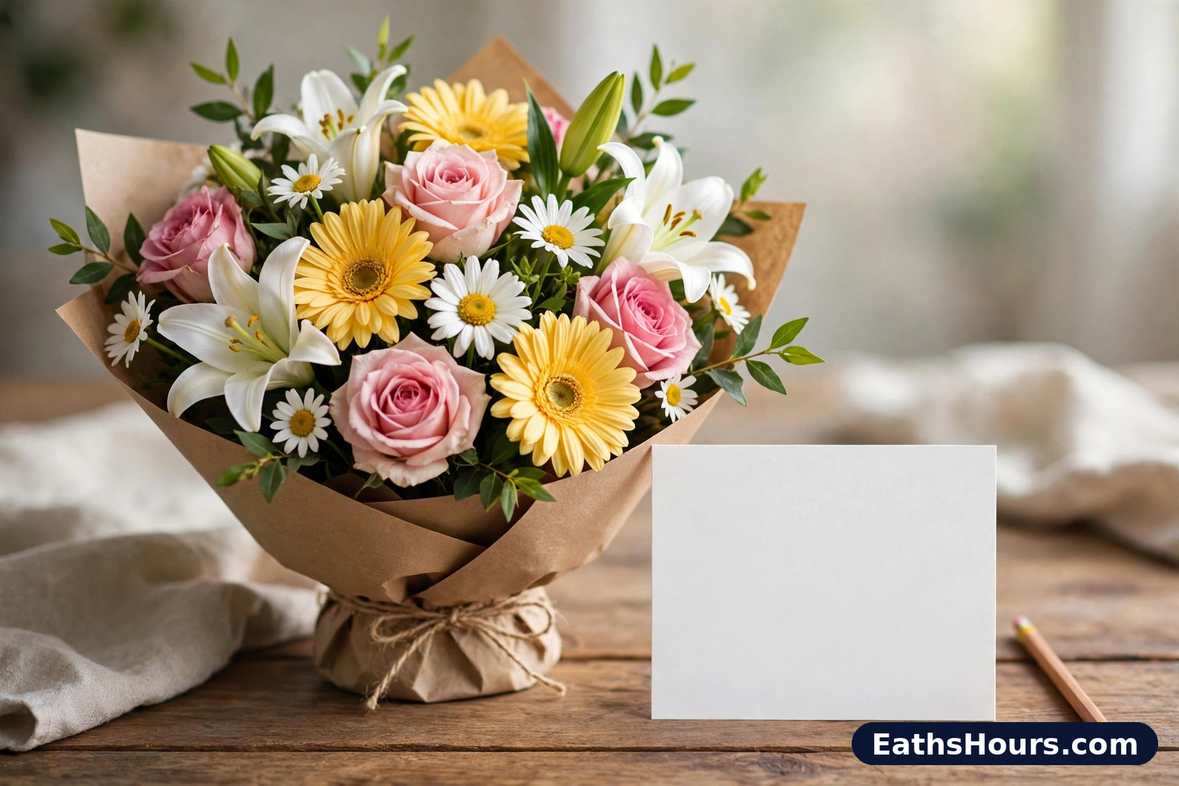
- Roses — the classic, read as beauty and harmony. Pink roses speak tenderness; yellow ones stand for friendship and happiness, which is why yellow is the friendship colour in a rose bouquet.
- Lilies — the elegant option, carrying sincerity and kindness. Beautiful and strongly scented, they suit a friend who loves a dramatic arrangement (one practical warning belongs with them — see the safety section below).
- Gerberas — the bright, cheerful daisies in saturated colours, standing for positivity and energy. Hard to give sadly; they look like a good mood.
- Orchids — refinement and a touch of luxury, the choice for a friend with polished taste. A potted orchid also outlasts every cut bouquet on this list.
- Daisies — the simple, charming option, standing for sincerity and the purity of a friendship that does not need dressing up.
Any of the five works. The best bouquet is the one that looks like her, not the one that follows a chart most obediently.
Flower Colours and What They Mean
Colour is the second language of a bouquet, and the guide’s five-colour reading is the conventional one:
- Yellow — joy, friendship and a sunny mood; the safest birthday colour between friends.
- Pink — tenderness, care and femininity; the gentlest register a bouquet can speak in.
- White — purity and sincerity; calm, clean and quietly elegant.
- Red — passion, first of all. The guide’s advice is worth keeping: for a friend, the other shades usually say the intended thing better, and red can be saved for the people it is meant for.
- Blue — calm and trust, a fitting colour for a steady, long-standing friendship.
Mixed bouquets let you speak in sentences rather than single words: pink for tenderness inside a field of yellow for joy is a combination no friend will misread.
What the Flowers Themselves Say: A Short Guide to the Language of Flowers
The meanings above are not modern invention; they descend from a real, documented custom. In the nineteenth century, especially in Victorian Britain, flowers were assigned coded meanings and used to send messages that politeness kept people from saying aloud — a practice called floriography, the language of flowers. Charlotte de la Tour’s Le langage des fleurs (Paris, 1819) was among the first published dictionaries of it, and Kate Greenaway’s The Language of Flowers (1884) became the best-loved English one.
Two honest cautions belong with the tradition. The dictionaries did not always agree with each other — nearly every flower collected several associations — so the meanings in circulation today are the consensus that survived, not a code anyone can be graded against. And meanings drift: the yellow rose, read as friendship and joy by every modern florist, appears in some Victorian lists under jealousy instead. The consensus that emerged for the commonest blooms runs like this: the red rose for love, the white lily for purity and sweetness, the daisy for innocence, the orchid for rare beauty and refinement. Gerbera’s cheerfulness is a modern addition to the list rather than a Victorian entry — the daisy family’s brightness simply earned it the place.
Use the language of flowers the way it works best: as a graceful extra layer. Choose blooms she loves, let the traditional meanings agree with your card where they can, and never let a dictionary overrule what you know about your own friend.
Choosing Safely: Allergies, Cats and Other Practical Checks
One section the bouquet guides usually skip, and the one that can matter most: a beautiful arrangement should never make anyone in her home unwell.
The serious warning concerns cats and true lilies. The ASPCA’s poison-control guidance is blunt: lilies of the Lilium family — the Asiatic, Easter, Oriental and stargazer lilies florists use — and daylilies are severely toxic to cats. Every part counts, including the pollen a cat might groom off its coat and even the water in the vase, and small amounts can cause severe kidney injury. If your friend has a cat, leave true lilies out of the bouquet entirely; roses, gerbera daisies and orchids all sit on the ASPCA’s non-toxic list for cats, so the swap costs the arrangement nothing.
For people, the practical checks are gentler. A friend with hay fever or a sensitive nose will fare better with low-pollen choices — orchids and roses are the usual recommendations — than with open, pollen-heavy blooms, and strongly scented flowers such as lilies and hyacinths can overwhelm a small room even when they cause no allergy. If she is scent-sensitive, ask the florist for lightly fragranced varieties and keep the bouquet’s perfume gentle. None of this needs to shrink the gift: it only needs a minute’s thought before the order, instead of an apology after it.
Original Ideas for Presenting the Bouquet
The guide’s four finishing touches are small, cheap and disproportionately effective:
- Add a card with warm words. A short, sincere wish turns flowers into a message; the whole second half of this page exists to help you write it.
- Combine the flowers with a small gift. A box of chocolates, a scented candle or a small plush toy rides along well — the bouquet stays the headline, the extra is the footnote.
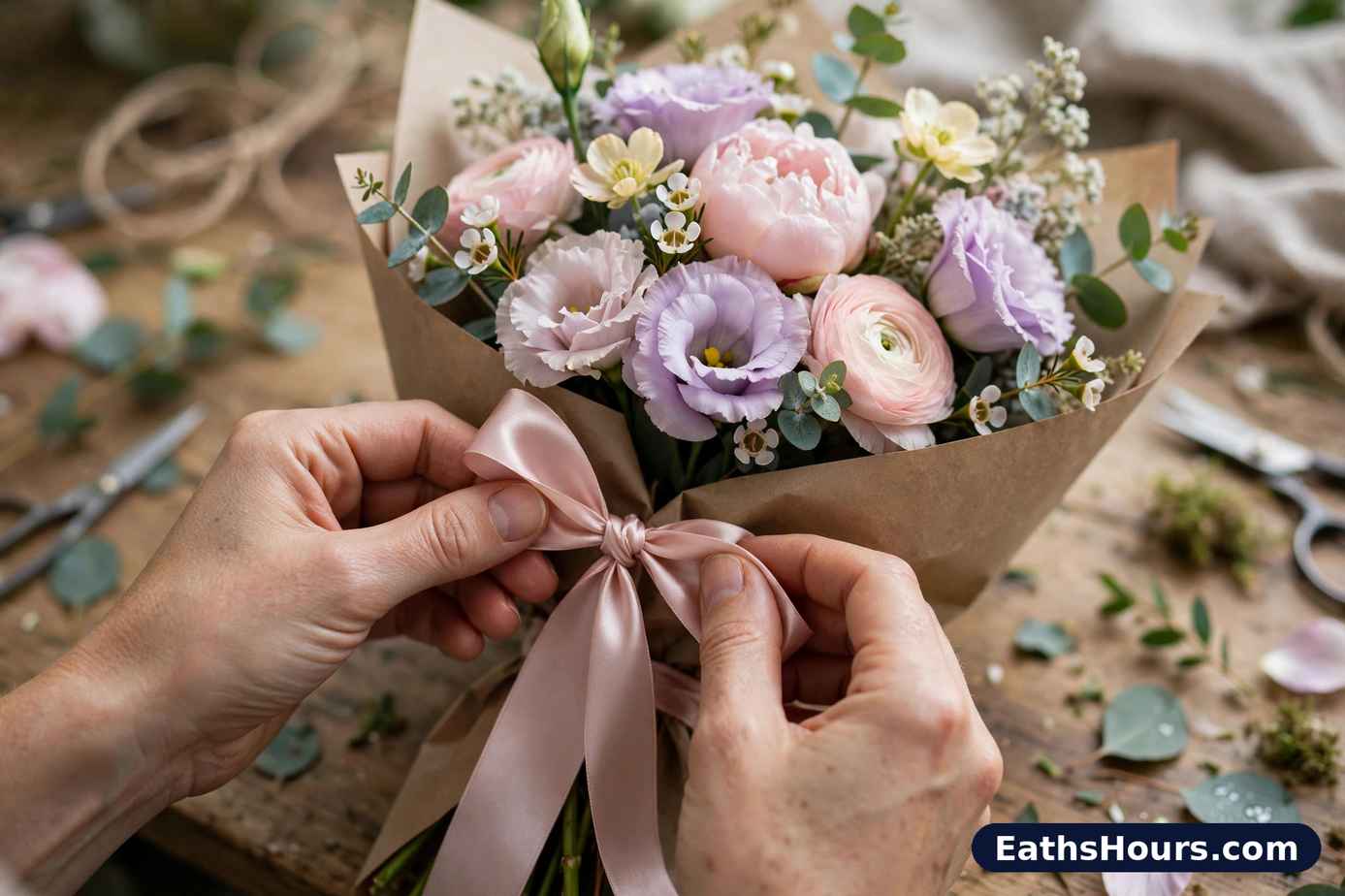
- Choose the wrapping deliberately. Stylish craft paper reads modern and warm; a bright ribbon reads festive. The wrap is the first thing she sees, so it is worth the extra minute at the counter.
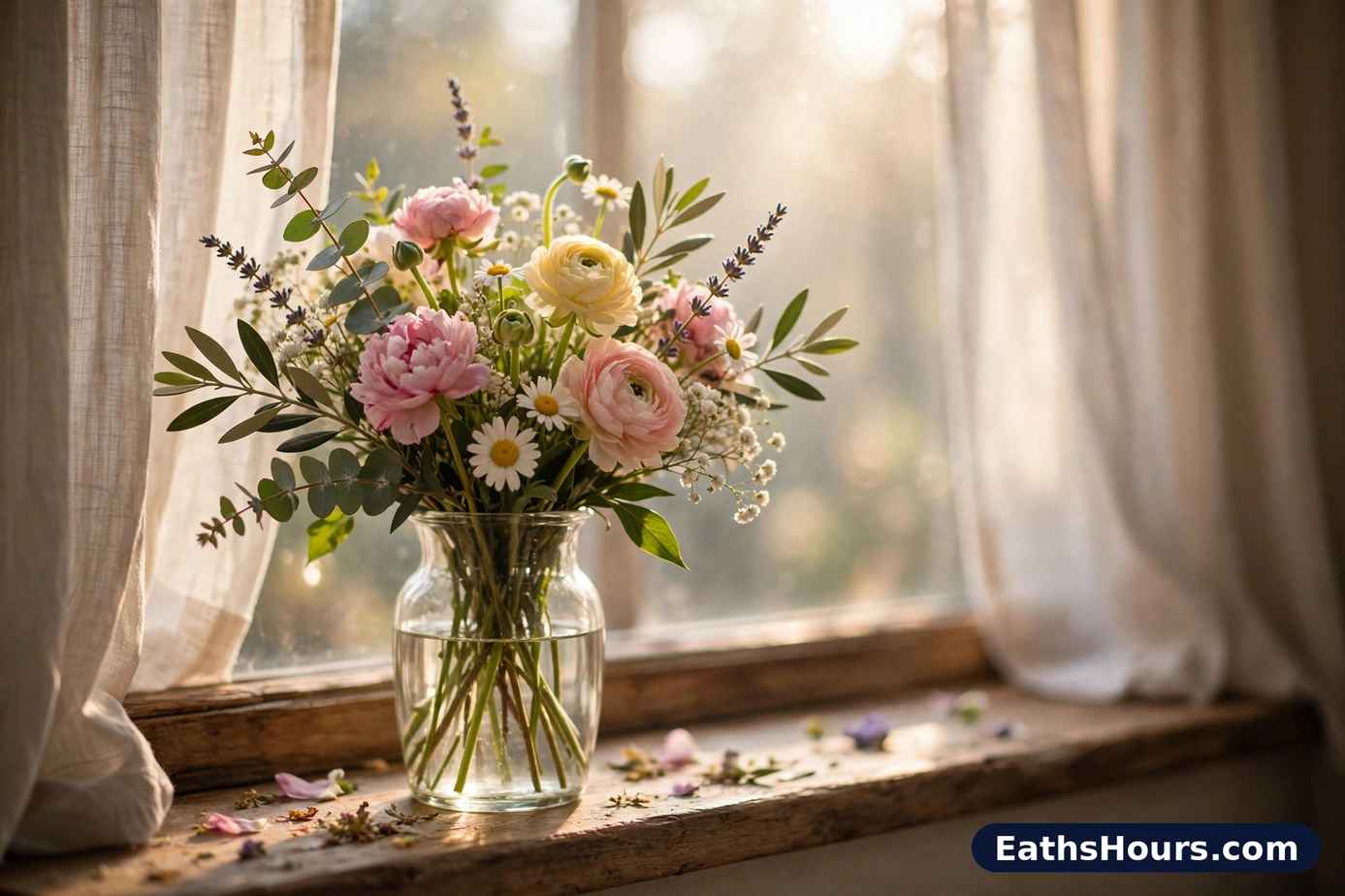
- Add dried flowers or green sprigs. Eucalyptus, lavender or gypsophila tucked between the fresh blooms adds texture and charm, and the dried pieces remain after the fresh ones fade.
How to Make a Flower Surprise for Your Friend?
Flowers handed over in person are a gift; flowers that arrive unexpectedly are an event. The guide lists five ways to arrange the surprise:
- Courier delivery. An unexpected knock and a bouquet at the door or the office desk produces the full effect — she gets the flowers and the story of receiving them.
- A flower box or hat box. The stylish modern alternative to a wrapped bunch: blooms arranged in a presentation box, no vase-hunting required on arrival.
- A living potted plant. An orchid, or a small cactus for the friend who jokes about her record with plants, keeps giving long after a cut bouquet would have faded.
- The morning surprise. Leave the bouquet at her door early, so the flowers are the first thing her birthday gives her.
- A flower photograph card. A card carrying a photograph of the bouquet with your personal greeting — the keepsake version, for a friend too far away to hand flowers to.
Whichever route you choose, sign the card with your name. Anonymous flowers are romantic in films and merely puzzling in real life — she should know exactly whose thoughtfulness arrived.
What Words Should You Write in the Greeting That Goes With the Flowers?
The guide illustrates the point with three example greetings of its own; this page answers with a library instead — the 24 fresh lines in the next section, composed for this article and free to copy exactly as they stand. Before you choose one, three small rules for the card itself.
First, keep it short. A bouquet card holds two or three sentences comfortably; a line that tries to say everything ends up saying it at postcard size, in handwriting that shrinks as it goes. Second, name one true thing — a shared memory, the quality of hers you admire most, the joke only the two of you would understand — because a single honest detail is worth more than a page of pretty general phrases. Third, sign it warmly and plainly. The flowers carry the ceremony; the words only need to carry the truth.
If none of the ready lines quite fits, take the closest one and swap in your detail. A borrowed shape with your own sentence inside it is not a shortcut — it is how most good cards get written.
Birthday Wishes to Write With the Flowers: 24 Fresh Lines
Twenty-four lines, sorted by tone — eight heartfelt, eight short enough for the smallest florist’s card, and eight playful ones for the friend who would roll her eyes at anything solemn. Each one is new, composed for this article.
Heartfelt
- “Happy birthday to the friend who has shared every season of my life — may this year hand you back even half the joy you hand out so freely.”
- “These flowers are a small, bright stand-in for a big truth: my life is better, funnier and steadier with you in it. Happy birthday.”
- “For every late-night call you answered and every hard day you talked me through — thank you, and happy birthday to my favourite person.”
- “I picked blooms as warm as your kitchen-table advice and as bright as your laugh. Have the happiest of birthdays, my dear friend.”
- “Another year of you in the world is worth celebrating loudly. May it bring you the same kindness you pour into everyone else.”
- “You have a gift for making ordinary days feel like occasions. Today the occasion is yours — happy birthday, with all my love.”
- “Distance, busy months and life’s noise have never managed to dull us. Happy birthday to the friend time cannot fade.”
- “May your year be soft where you need rest, bold where you want change, and full of people who love you the way I do. Happy birthday.”
Short and Sweet
- “Happy birthday! Flowers for my favourite flower-loving friend.”
- “A little colour for the person who colours every room. Happy birthday!”
- “For you, on your day: something almost as lovely as you are.”
- “Happy birthday — may your year bloom as brightly as these do.”
- “Short card, big feelings: happy birthday, dear friend.”
- “These were the brightest in the shop, and they still came second to you.”
- “Wishing you a day as warm and generous as your heart. Happy birthday!”
- “Picked fresh, given gladly. Happy birthday!”
Playful
- “Happy birthday! I watered these with compliments all the way home, so they should last for ages.”
- “These flowers are contractually obliged to wilt before you do. Many happy returns!”
- “I asked the florist for something that says ‘she’s fabulous and only slightly older’. She nailed it.”
- “Happy birthday to my partner in crime — the blooms are your alibi; you were receiving flowers at the time.”
- “Like these flowers, you get more impressive every year and require surprisingly little maintenance.”
- “Cake is temporary, but a bouquet photographs better. Happy birthday, superstar.”
- “I considered a plant you cannot kill, but I believe in you. Happy birthday!”
- “Another year more fabulous. The flowers are jealous, and frankly, so is the cake.”
How to Keep Her Bouquet Fresh for Longer
A bouquet’s lifespan is decided mostly in its first hour and by a few small habits after that — florist advice is remarkably consistent on the routine:
- Start with a clean vase. Residue from the last arrangement feeds bacteria, and bacteria clog stems; wash the vase with hot, soapy water before the flowers go in.
- Trim the stems. Cut two or three centimetres off each stem at a 45-degree angle with a sharp, clean blade, and strip away every leaf that would sit below the waterline — submerged leaves rot and cloud the water.
- Use the flower food. The little sachet taped to the wrapping is not decoration: it feeds the blooms and slows bacterial growth. Stir it into fresh, room-temperature water.
- Refresh every two days. Change the water completely, rinse the vase, and snip a little more off the stems; cloudy water is already overdue.
- Mind the spot. Keep the vase somewhere cool, out of direct sunlight and away from heat — and away from the fruit bowl, since ripening fruit gives off ethylene gas that ages flowers early.
Followed even loosely, the routine stretches a bouquet from a few days toward a fortnight, which means the birthday lasts longer too.
Frequently Asked Questions (FAQ)
Which flowers suit a friend’s birthday best?
Roses, lilies, daisies, gerberas and orchids are the classic five — between them they stand for friendship, joy and sincerity. (Skip true lilies if she has a cat.)
Can you give a friend yellow flowers?
Yes. Whatever the old superstitions say, yellow reads as joy, positivity and warm friendly feeling — between friends it is the happiest colour in the bunch.
How should you arrange a bouquet for a friend?
Keep it simple and deliberate: craft paper or a hat box, a ribbon that matches her taste, and a sprig of eucalyptus or gypsophila for texture.
What else can you add to the flowers?
Chocolates, a card with real words in it, a scented candle, fragrant oils — or a book, if she is a reader.
How do you make a surprise with flowers?
Send them by courier, leave them at her door early in the morning, or hand them over with the signed card tucked inside — surprise plus signature beats mystery.
Conclusion
Choosing birthday flowers for a friend comes down to three things: blooms that look like her, colours that say the friendly part out loud, and a delivery that turns a gift into a small event. Add a card with one true sentence on it — borrowed from the library above or written from your own memory of her — and the bouquet does the rest.
The Victorians built a whole floriography out of the idea that flowers speak before words do. They were right about the speaking; the words are still worth adding. Pick the flowers, write the line, sign your name — and let her birthday begin with both.